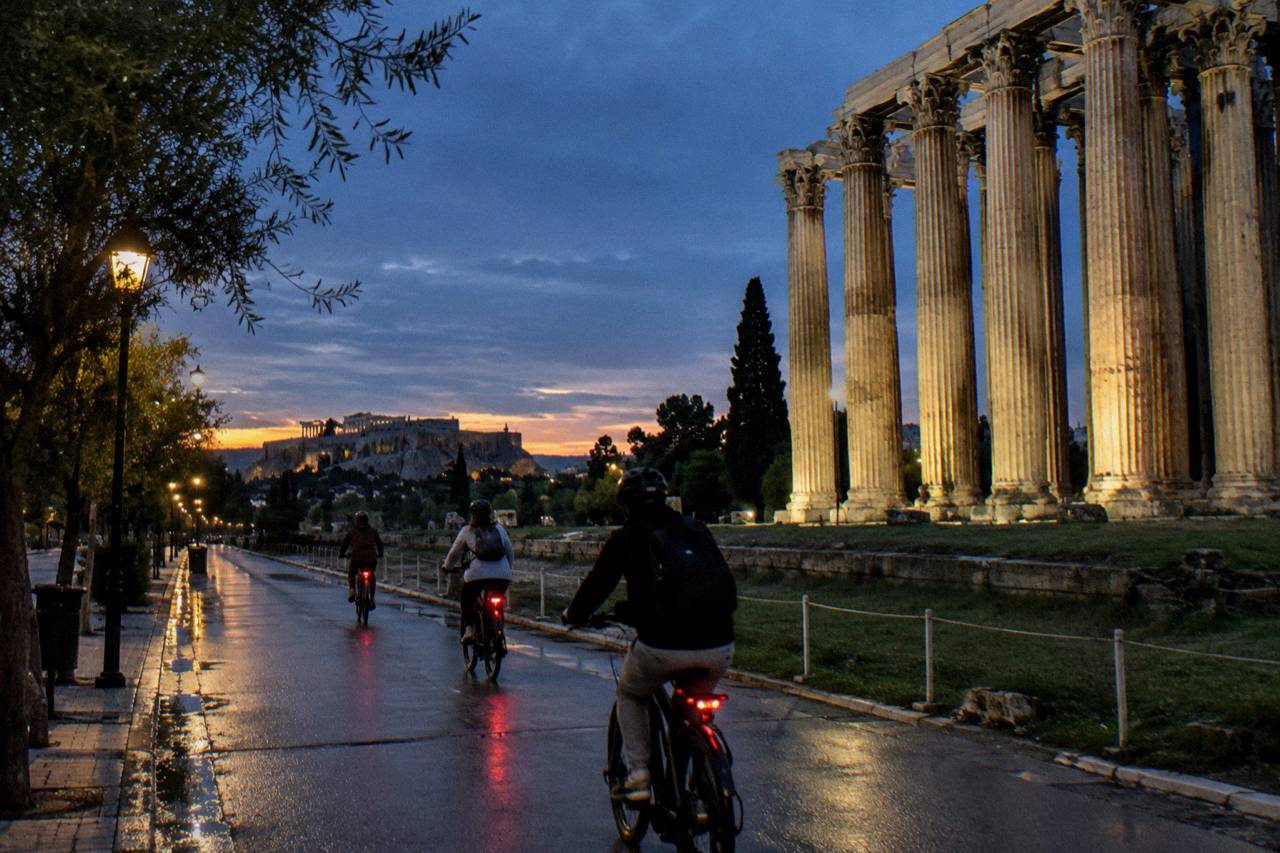
Where To Avoid In Athens At Night?
Practical, street-level guidance on where to be careful after dark in Athens: traffic squares, unlit park paths, marble slopes, and why evening guided bike rides exist.
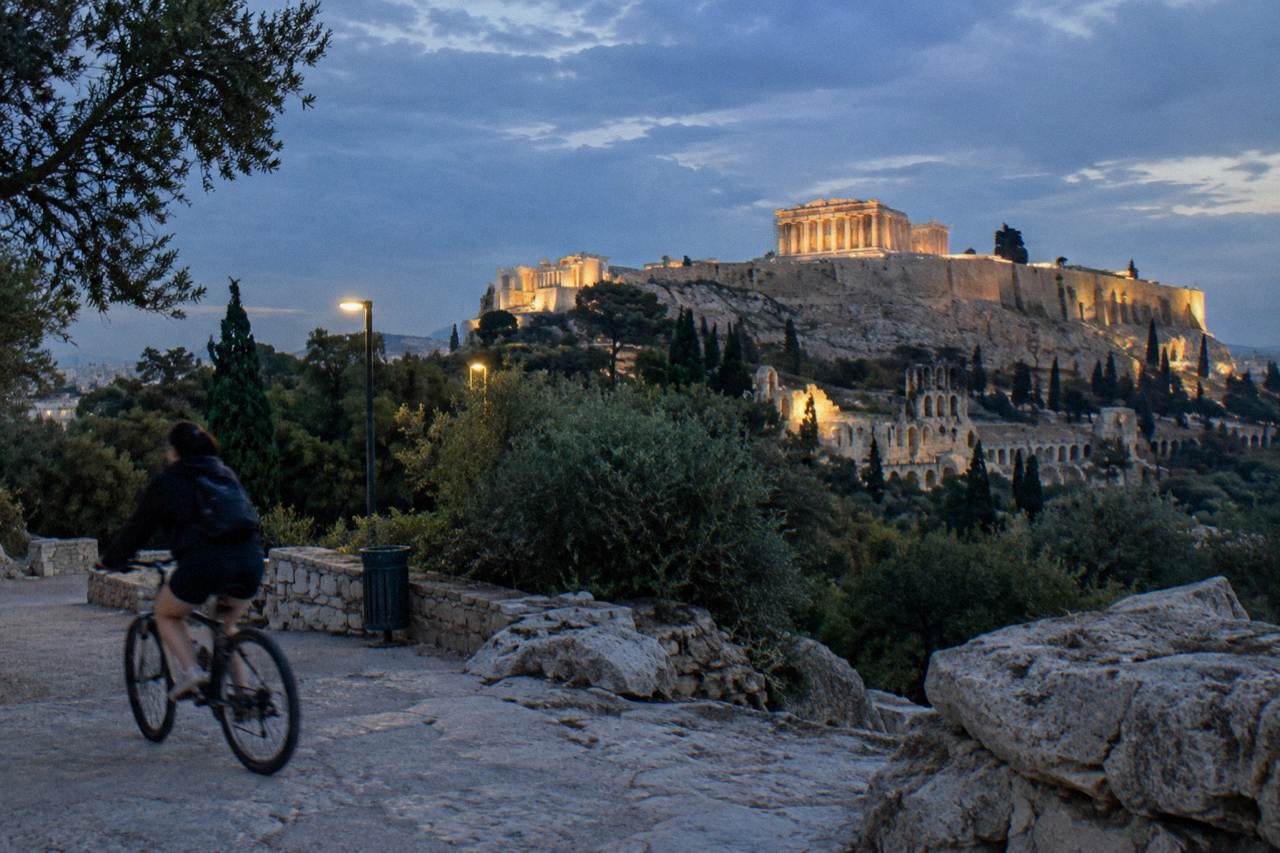
Athens after dark has no no-go map; most concerns come down to streets and timing. It has a friction map. The places that deserve care after sunset are the ones where traffic, poor lighting, and polished stone stack up against a visitor who does not know the street: the busy squares where cars and motorbikes thread through crowds, the park paths that lose their lamps as they climb, and the marble slopes that turn slippery the moment the evening dew settles.
That is also why evening guided rides exist. A local guide who leads night rides can point out which lanes are poorly lit and which crossings stay busy after the evening theater crowd heads home. The sunset ride with regular bike or e-bike option exists precisely for this: a 2 hour 30 minute loop, groups capped at 12, from $33.24 per person, rated 5.0 across 169 reviews.
There is no neighborhood in central Athens that should be crossed off after dark. The real caution zones are specific conditions: major traffic squares and avenues after the evening rush, unlit paths inside parks and on hills, and marble surfaces that turn slick with night moisture. Narrow the question from whole districts down to street types and the risk picture becomes practical instead of scary.
Athens is, by Mediterranean capital standards, a late city. In many tavernas, dinner service only gets going around nine, and the streets below the Acropolis stay lively well after midnight during the warm months. That street life is an asset: the well-walked routes around Plaka, the pedestrian arc under the Acropolis, and the squares of Psyrri and Koukaki are all places where company is a form of lighting.
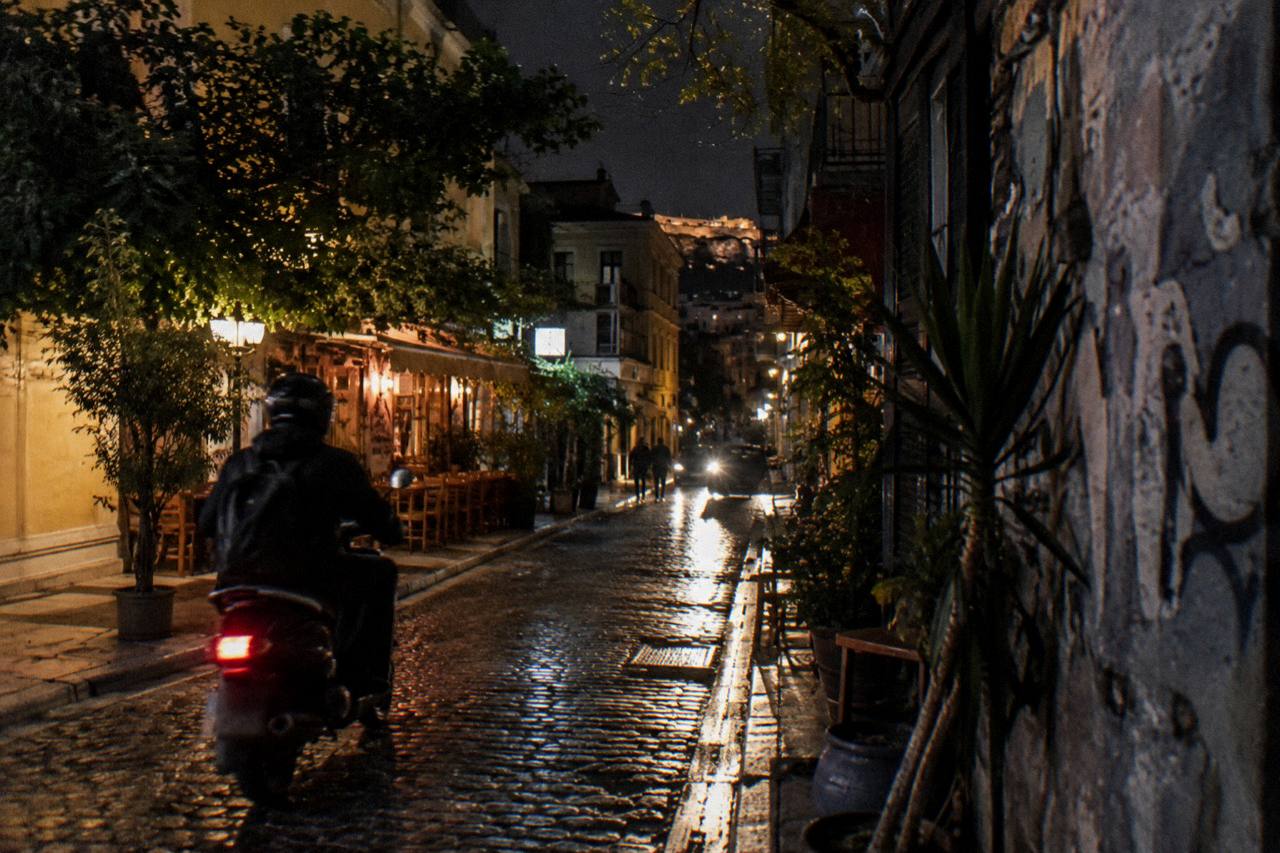
The friction points are elsewhere. Syntagma and the big avenues around it, Omonia's ring of one-way streets, and the fast dual carriageways that border the archaeological park all behave differently at night: less foot traffic on the crossings, faster motor traffic on the straights, and a fair number of motorbikes using the gaps. A cyclist or a walker making a straight line across any of these after dark is doing something locals time carefully.
None of this argues for staying in. It argues for knowing which environments after dark reward a slower pace and a guide, and which are as easy at ten at night as at ten in the morning. The sections below break those environments down one by one.
Which Athens Streets Are Trickiest After Dark?
The streets that ask for the most care after sunset are the traffic-heavy ones: the major squares with multi-lane crossings, the avenues along the edge of the historic center, and any one-way street where motorbikes use the margin between parked cars and the curb. None of these are dangerous to a careful rider, but all of them punish the assumption that a car will behave the way it does at noon.
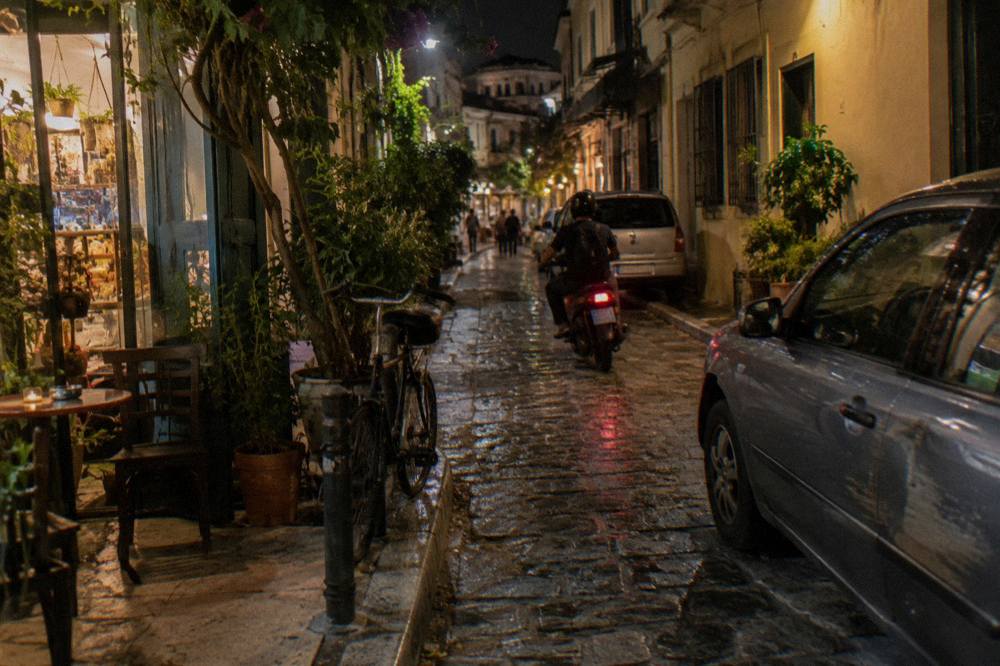
Athens traffic has a rhythm, and the rhythm changes at night. During the day, congestion slows everything down to a crawl that a bicycle can negotiate. After the evening rush drains away, the same streets run faster and emptier, which sounds safer and is, for the stretch you can see, until a car comes through a dim side street at a speed it would never attempt at noon. Local riders treat nighttime crossings with more respect than midday ones, not less.
The second friction point is the motorbike margin. In much of the center, motorbikes and scooters ride the strip between the parked cars and the curb, exactly where a cautious cyclist instinctively positions. After dark, that strip is where bikes appear with less warning. The defensive habit is to hold a visible line near the parked cars rather than hugging the curb, and to assume the margin is in use even when it looks clear.
Then there is the infrastructure question. Greek road law is specific here: where a cycle lane exists, cyclists must use it and may not ride in the rest of the carriageway, per Article 44 of the road code. In practice the center has only scattered lanes, so most night riding in Athens happens in mixed traffic. That is legal and normal, but it places the full weight of the decision on the rider's own eyes, which is the honest argument for a guide who already knows the crossings.
The general safety habits translate directly: lights front and rear, no hand-held phone or smartwatch while riding, no headphones, never two abreast. Those are not stylistic preferences. Under the road code the phone and headphone violations carry fines of 350 EUR each, and riding two abreast carries 30 EUR, per the Ministry's published table of road-code fines.
How Dark Are Athens Parks And Hills After Sunset?
Very. The green spaces in and around the center, Lycabettus Hill most of all, lose their lighting fast once the maintained paths end, and the hillsides that are pleasant scrambles by day become genuinely hard footing at night. The rule of thumb locals use is simple: if a path needs your phone's flashlight going up, it needs it coming down too, and a descent in the dark is worse.
Lycabettus deserves its own paragraph because it is the hill everyone wants at sunset and the one that punishes improvisation. The funicular and the upper terraces are lit and busy around dusk, but the network of footpaths that crisscrosses the slopes below the top is patchy at best, with long stretches where a pleasant dirt track narrows between scrub and loose stone. By day that is a fun shortcut. After dark it is the single most common way visitors on foot end up lost, scratched, and walking their bike downhill.
The National Garden is the other classic case. It is a lovely green lung in the daytime, and its gates keep posted hours that shift with the seasons, so the practical night question is not is it safe inside but is it even open, and after closing the answer is no. The surrounding streets are well-lit and busy, so the garden is a daytime destination and never a nighttime through-route.
Pedion tou Areos, the park near the National Archaeological Museum, sits in between: partly lit, partly rough, and quiet after the evening dog walkers go home. It is not a place to warn people off, but it is a place where the "walk where pedestrians are endangered" rule from the road code becomes literal, since Article 44 requires cyclists to dismount and walk when they obstruct or endanger pedestrians on shared paths.
The takeaway is not avoidance of every green space. It is timing. Hills and unlit paths reward the golden hour and punish the late return. This is exactly the window the evening guided rides are built around: they summit or loop while the light lasts, then descend on lit streets. If a self-guided ride drifts past sunset, the smart move is to route home along the bright commercial streets rather than the pretty dark ones.
Is It Safe To Walk Around Athens At Night?
Yes, in the parts of the center visitors actually use, and with the same basic habits any big city asks for. The pedestrianized core around Plaka, Monastiraki, and the Acropolis approaches stays lively and well-lit late. The caution is not crime but footing: dropped curbs, polished marble sidewalks, scaffolding, and the occasional open cellar door outside a shop.
Athens has a broad, safe-feeling night culture, and that is worth stating plainly because the question is usually asked with the city's 2010s reputation in mind. In season, the areas most visitors walk after dark, Plaka's stepped lanes, Monastiraki's square, the Thiseio promenade, stay lively and lit into the late evening. The classic evening stroll from the Acropolis line toward the old town is the city's own nightly ritual.
The real night hazard for pedestrians in Athens is geological. Much of the center's sidewalk is marble, and marble that has been walked smooth for decades becomes astonishingly slippery when the evening dew comes down. Locals step around the polished patches without thinking about it. Add a scooter lane, a dropped kerb with no ramp, and streetlights that end abruptly at a construction fence, and the night walk demands more attention than the noon walk.
There is one more honest note: the hours when the streets empty out between about three and five in the morning are the hours when any city, including this one, is at its least supervised. That is not an Athens-specific warning, and it does not single out any district. It is simply true everywhere that the buffer of foot traffic is part of the safety of a night walk, and the buffer thins in the small hours.
For riders, the same logic applies with the added weight of Greek law: at night a bike needs its lights. Article 80 of the road code requires a white or yellow front light, a red rear light or reflector, side reflectors, and pedal reflectors, with a 30 EUR fine attached. Every tour bike on the evening rides carries these as part of the package, which removes one more thing to think about.
Which Athens Neighborhoods Feel Best At Night?
The districts that shine after dark are the ones built for it: Plaka and the Acropolis approaches for the floodlit monuments, Psyrri and Monastiraki for bars and street life, Koukaki and Thiseio for the calm promenade, and Glyfada along the coast for a sea breeze and a flat ride. Each rewards a different kind of evening, and all of them are on existing guided routes.
Plaka after dark is the obvious answer and still the right one. The neighborhood's stepped lanes shut out most car traffic in the evenings, the floodlights on the Acropolis above turn the whole hillside into a lantern, and the density of restaurants keeps foot traffic steady. It is the closest thing central Athens has to a car-free evening zone, and several night bike tours route through it.
“The route was amazing, very safe & scenic! Had plenty of time for photos and water. Lovely stop for a local snack. Cannot recommend highly enough”
Psyrri, just west of Monastiraki, is the district that stays up latest. Its grid of small streets fills with bars and music venues after ten, which means the traffic thins as the crowds grow. For a rider, that trade is favorable: fewer cars and motorbikes, more pedestrians to give way to. The road code's dismount-when-endangering rule gets a workout here, and that is by design.
Koukaki and Thiseio, along the pedestrian promenade under the Acropolis, are the quiet half of the evening. The broad walkway stays car-free, lit, and strollable all night, and the evening view of the illuminated hill from the Apostolou Pavlou stretch is one of the city's best free sights.
Glyfada, along the coast to the south, is a different animal: flat, sea-facing, and built around a long evening promenade rather than ancient monuments. The coastal tour options that start from Vergoti Square in Glyfada trade the Acropolis view for sea air and wide lanes, and the smaller group cap of six on the Riviera rides reflects the quieter roads. For a visitor staying near the sea, the coast after dark is the easiest night terrain in the Athens area, and the Athens Riviera guide covers the daytime version in depth.
The common thread across all four is light plus people plus traffic calming. Choose streets that have two of the three and the third usually follows.
Why Do Guided Night Rides Exist At All?
Because the hardest parts of night riding in a new city are route knowledge and pace, not stamina. A guide supplies the lit descent, the timed crossing, and the judgment call at a dark intersection, and the group format puts riders in a visible blob of moving lights instead of alone. The evening tours are essentially outsourced local judgment with a bike attached.
Every reason above for caution after dark, the traffic rhythm, the motorbike margin, the slick marble, the unlit park path, is a knowledge problem before it is a skill problem. A rider who has done the route twenty times handles all of it without thinking. A rider who has done it zero times handles it by luck. A guided night ride is the difference between those two states, purchased for the price of a ticket.
The practical mechanics also matter. Tour bikes come with the lights the law requires, helmets come with the package, and the guide sets a pace that suits the group rather than the rider's own optimism. On the evening routes the groups stay small: twelve on the sunset loops, around eight on some of the city night rides, and twenty is the largest band on any ride in this category. Small groups mean the guide can actually manage the crossings rather than just herding.
The sunset ride runs the golden-hour loop with a choice of regular bike or e-bike and tops out at twelve riders. The 2-hour night highlights e-bike ride is the compact after-dark version, 2 hours on an e-bike with bottled water included, rated 4.9 across 580 reviews and from $54 per person. The night city ride with Greek treat adds a snack stop to a 3-hour e-bike loop, 4.8 across 105 reviews, from $51.
- Riviera And Coast Rides$28.66
- E-Bike Tours$33.24
- Sunset And Night Rides$33.24
- City And Acropolis Rides$40.12
- Private And Day Trips$61.90
That drink-and-snack detail is worth pausing on, because it reflects what night riding in Athens actually is. The point of the evening rides is rarely aerobic. It is the floodlit monuments, the cooled streets, the empty crossings at the right hour, and the stop somewhere along the way. The listings frame them as sightseeing at the hour the city looks its best.
For a fuller breakdown of what the evening category contains and how the formats differ, the Athens night bike tour guide walks through the whole set. And for anyone still weighing whether a paid tour beats simply renting a bike, that question gets examined on its own terms elsewhere on this site.
What Should A Rider Actually Watch For At Night?
Three things, in order: lighting gaps, surface changes, and crossings. The lighting gap is where a lit street hands off to a dark one, the surface change is where asphalt turns to cobbles or marble, and the crossing is where a bike has to negotiate with cars that can see the rider worse than the rider can see the cars. Late-night trouble in the center tends to cluster in a few well-known spots.
The lighting gap deserves special attention because it is the one people underestimate. Riding out of a brightly lit commercial street into a residential one feels like nothing has changed, but it takes the eyes several seconds to adapt, and those seconds are exactly when a pothole or a parked car's open door appears. The habit is to slow before the transition, not after it. Guides do this without announcing it, which is one reason a guided night ride feels smoother than it has any right to.
Surface changes are the Athens specialty. The center mixes asphalt, concrete slabs, cobbles, and marble panels, sometimes within one block, and the smooth parts get polished by decades of foot traffic until they are slick when damp. Evening dew makes it worse, and light rain makes it genuinely hazardous. The defensive move is braking before a marble patch rather than on it, and taking cobbled lanes straight rather than at speed.
Crossings at night reward patience. The signals work the same as by day, but the gaps drivers take are bigger, and the road code attaches a 150 EUR fine to running a red bicycle signal, a sign of how seriously the rule is taken. Running a red on a bike at night is not a shortcut, it is the single worst judgment available to a rider in the city, because the cross traffic is moving fast and looking for cars, not bicycles.
The law also has a few quiet rules worth knowing before a night ride: no passengers on a bike outside the specific exceptions in Article 44, no headphones in the ears, both hands on the bar except when signaling, and a helmet that is recommended rather than mandatory for bicycle riders. The tours hand riders a helmet with the bike and expect it worn, which is the sensible norm even where the law stops at a suggestion.
When Is The Best Season For Night Riding In Athens?
Late spring through early autumn, with the sweet spot in May, June, September, and October, when evening temperatures sit in the low twenties and the streets stay social until late. July and August nights are warm but rideable after sunset, and the wet months from November through February make the marble genuinely treacherous and the lighting gaps matter more.
The climate record for the Elliniko coastal station puts July and August mean temperatures at 28.3 and 28.2 degrees, with maxima near 32.2, and barely two rain days in either month. By day that is oven weather for cycling, which is exactly why the sunset and night formats exist: they move the riding into the hours when the city cools. Central Athens runs warmer than the coastal station by day, and the same difference shrinks after dark.
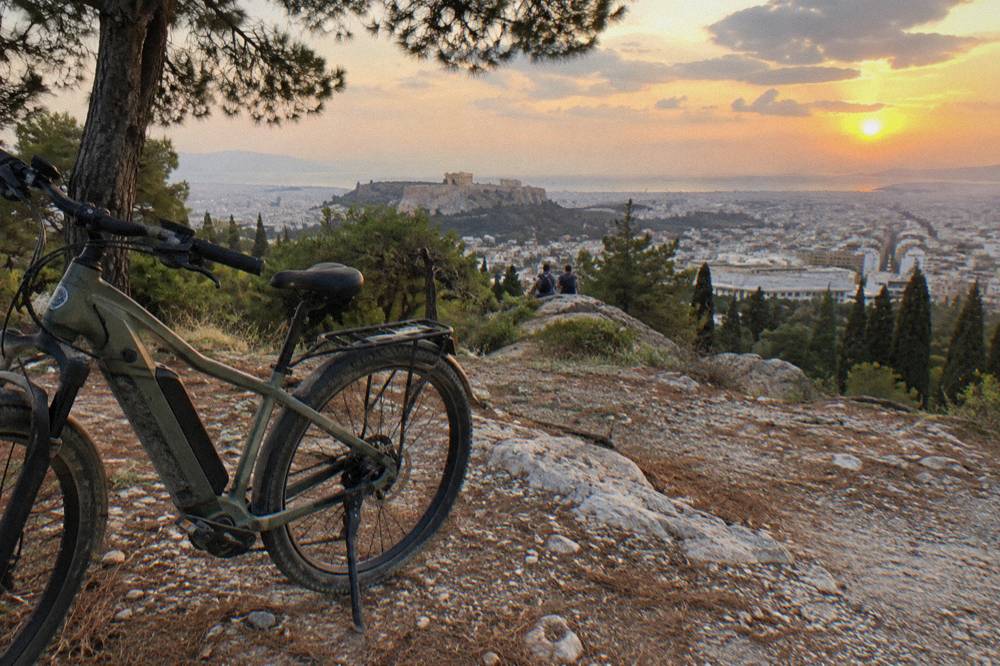
The shoulder months are the connoisseur's pick. May and October evenings are mild enough that a 2 to 3 hour ride is comfortable in a light layer, and September combines warm seas, emptying streets, and long twilights. November is the first month where the caution shifts from heat to wetness: the climate normals show 60.1 mm of rain across 10.9 days for November, rising to 62.0 mm across 13.5 days in December, and a wet marble slab at night is the single surface a rider should treat with the most respect.
| Evening factor | June to August | September to October | November to February |
|---|---|---|---|
| Typical after-dark feel | Warm, social streets late | Mild, long twilights | Cool, damp surfaces |
| Main night hazard | Heat lingering in stone | Earlier dark by October | Slick marble, rain days |
| Sunset ride timing | Departs well before sunset | Golden hour still generous | Short window, starts early |
| Rain days per month | Under 4 | 4.7 to 8.6 | 10.9 to 13.5 |
One seasonal note belongs to the calendar rather than the climate table. The 43rd Athens Authentic Marathon runs 7 and 8 November 2026. The closure decree bans all vehicles, bicycles included, on Irodou Attikou and Vas. Georgiou B from Thursday 5 to Monday 9 November, while Vas. Konstantinou, Arditou and M. Mousourou close from Friday 6 November 15:00 to Sunday 8 November 22:00. A rider planning independently that weekend should check the marathon's official site and expect detours around the closed corridors; a guided evening ride that weekend would route around them by design.
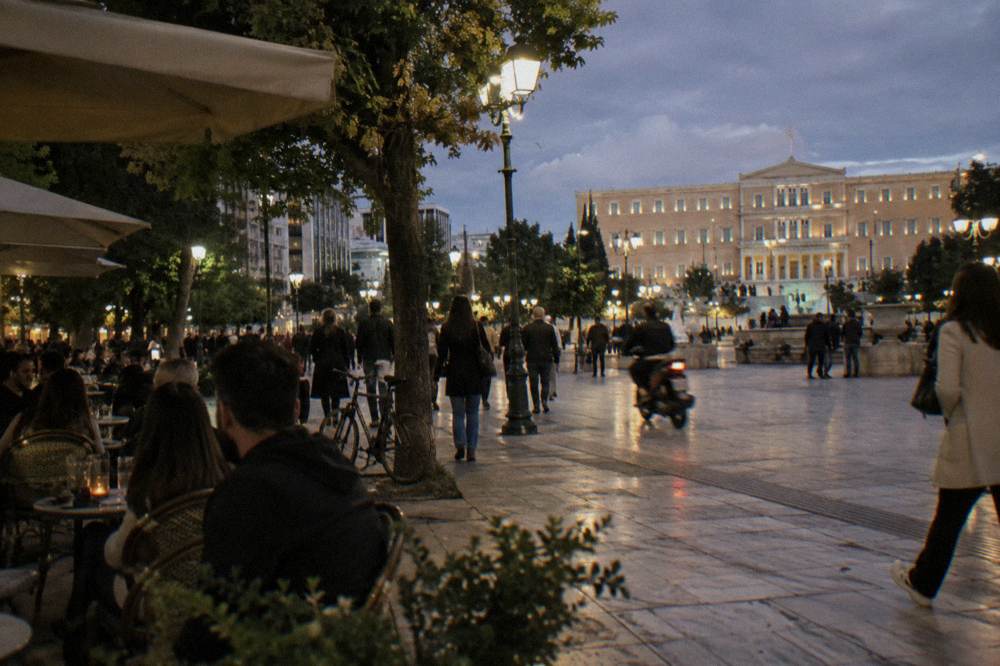
The practical summary of all of it: Athens at night is a good city to be out in, with a short list of conditions that deserve respect. Give the traffic squares a slow eye, the hills a turnaround time, and the marble a dry-weather check, and the evening becomes the best hours the city has. The site this article appears on, Bike Tours Athens, exists because the after-dark hours are when the city's evening rides are at their best, and the tours that run them are worth understanding before booking one.
Common Questions About Athens At Night
Where To Avoid In Athens At Night?
Nothing in central Athens is off-limits after dark. The caution zones are conditions rather than districts: busy traffic squares and avenues after the evening rush, unlit paths on parks and hills, and polished marble sidewalks that turn slick with night moisture. Stick to lit, busy streets, and the after-dark city is one of its best hours.
Is Athens Safe To Walk Around At Night?
In the parts visitors actually use, yes. Plaka, Monastiraki, Psyrri, and the Acropolis promenade stay busy and lit late into the evening in season. The realistic night hazard is footing, dropped kerbs, smooth marble, and construction fences, rather than anything else.
Do I Need Lights To Ride A Bike At Night In Athens?
Legally, yes. The Greek road code requires a white or yellow front light, a red rear light or reflector, side reflectors, and pedal reflectors after dark, with a 30 EUR fine attached to riding without them. Every guided evening tour provides a lit bike as part of the package.
Are Helmets Mandatory For Night Bike Rides?
For bicycles, no. Under the road code a helmet is recommended, not mandatory, for bicycle riders, and that includes e-bikes sold as bicycles. The tour operators hand riders a helmet with the bike anyway, and wearing it on an evening ride is the sensible default.
Which Night Bike Tour Of Athens Should I Choose?
It depends on the format. The Sunset Ride, Regular or E-Bike runs 2 hours 30 minutes from $33.24 per person with a choice of bike type. The 2-Hour Night Highlights E-Bike is the compact after-dark loop, from $54. The Night Ride, Greek Treat Included runs 3 hours with a snack stop, from $51. All three are guided and all include the bike.
What Time Do The Evening Bike Tours Start?
The sunset tours are built around the golden hour and their start times shift with the season, so the exact departure time for a given date lives on the operator's booking page. Checking availability for a specific day is the only way to see the real start time.