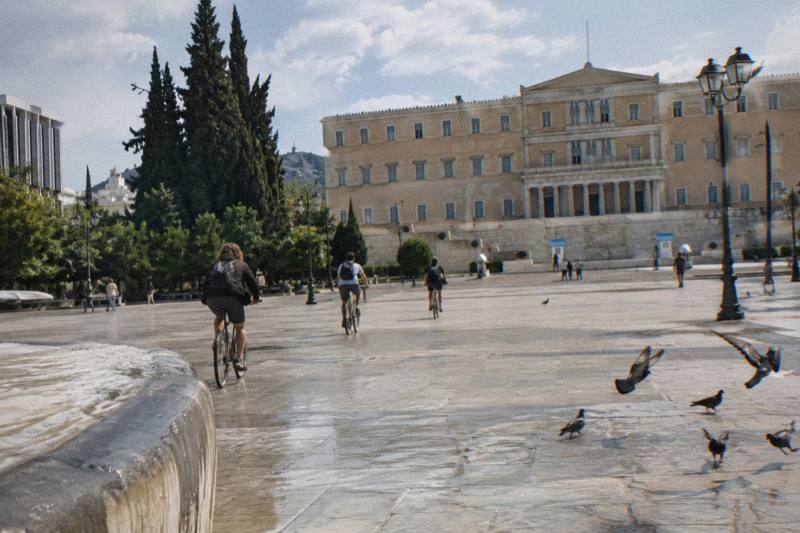
Ancient Agora Athens: Tickets, Hours And What To Expect
The Ancient Agora was the civic heart of classical Athens, and it sits directly on the route most historical-centre bike rides follow. This guide covers what the site holds, how entry and tickets work, and the rides that pass its edges.
Short answer
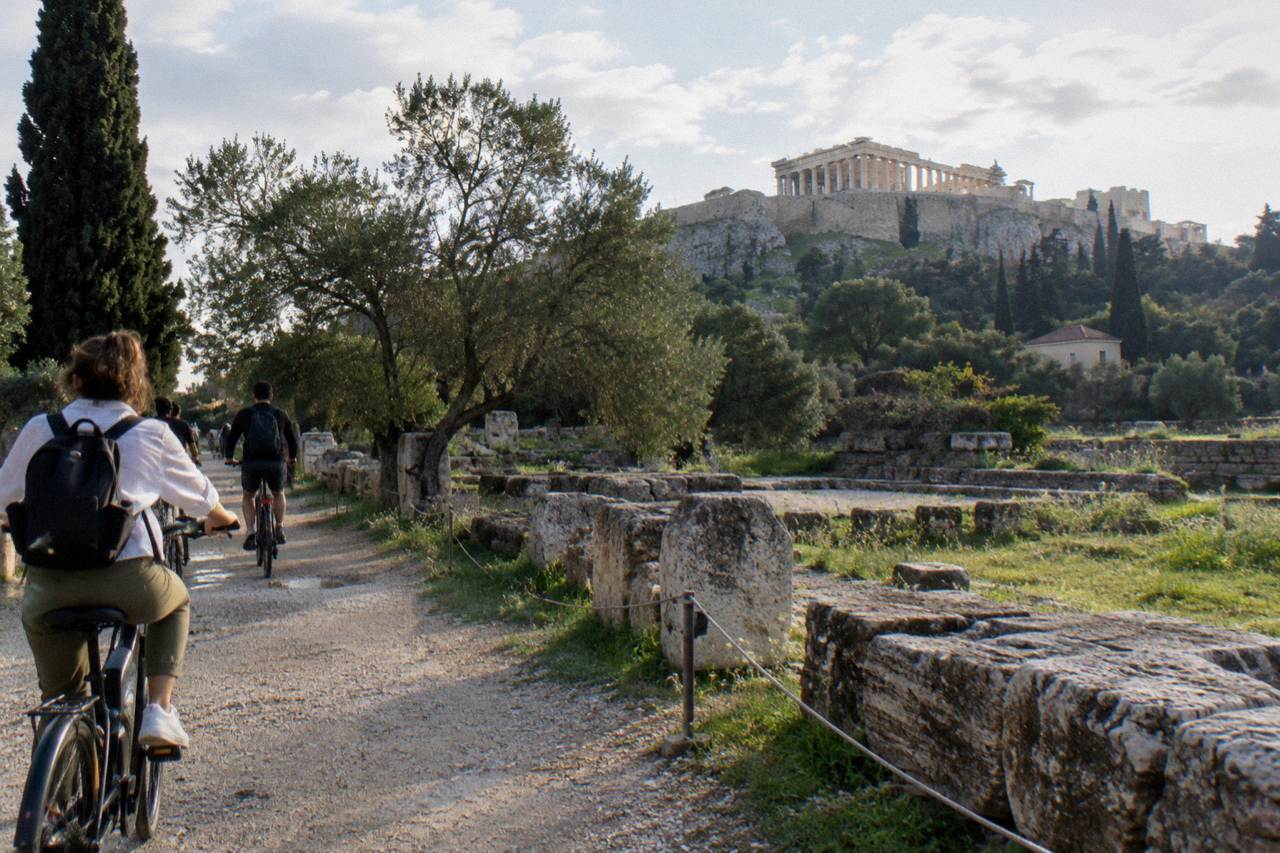
The Ancient Agora lies northwest of the Acropolis, below the hills of the classical city, and most guided historical-centre rides pass beside it. Entry details, prices and opening hours are published on the official archaeological sites ticket page, not here. Rides that pass the area start from about $45 per person and run about 3 hours.
What Is The Ancient Agora Of Athens?
The Ancient Agora was the public square and civic centre of classical Athens: the place where law courts, assemblies, markets and public debate ran, spread below the Acropolis between the hills of the Areopagus and the Kolonos Agoraios. Unlike the temples on the hill above it, the Agora was a working district, rebuilt and replanned across centuries, and today its remains sit inside a fenced archaeological park a few minutes from Monastiraki and Plaka.
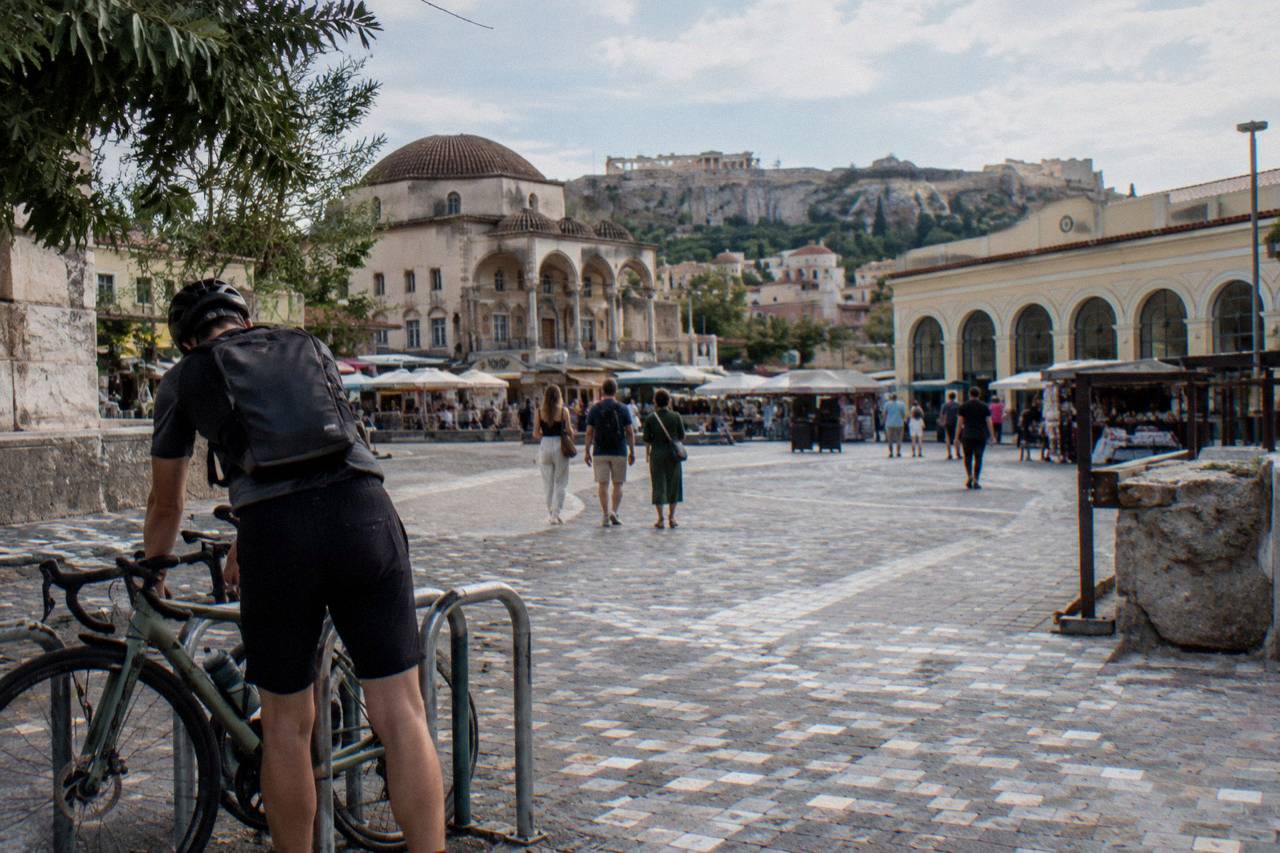
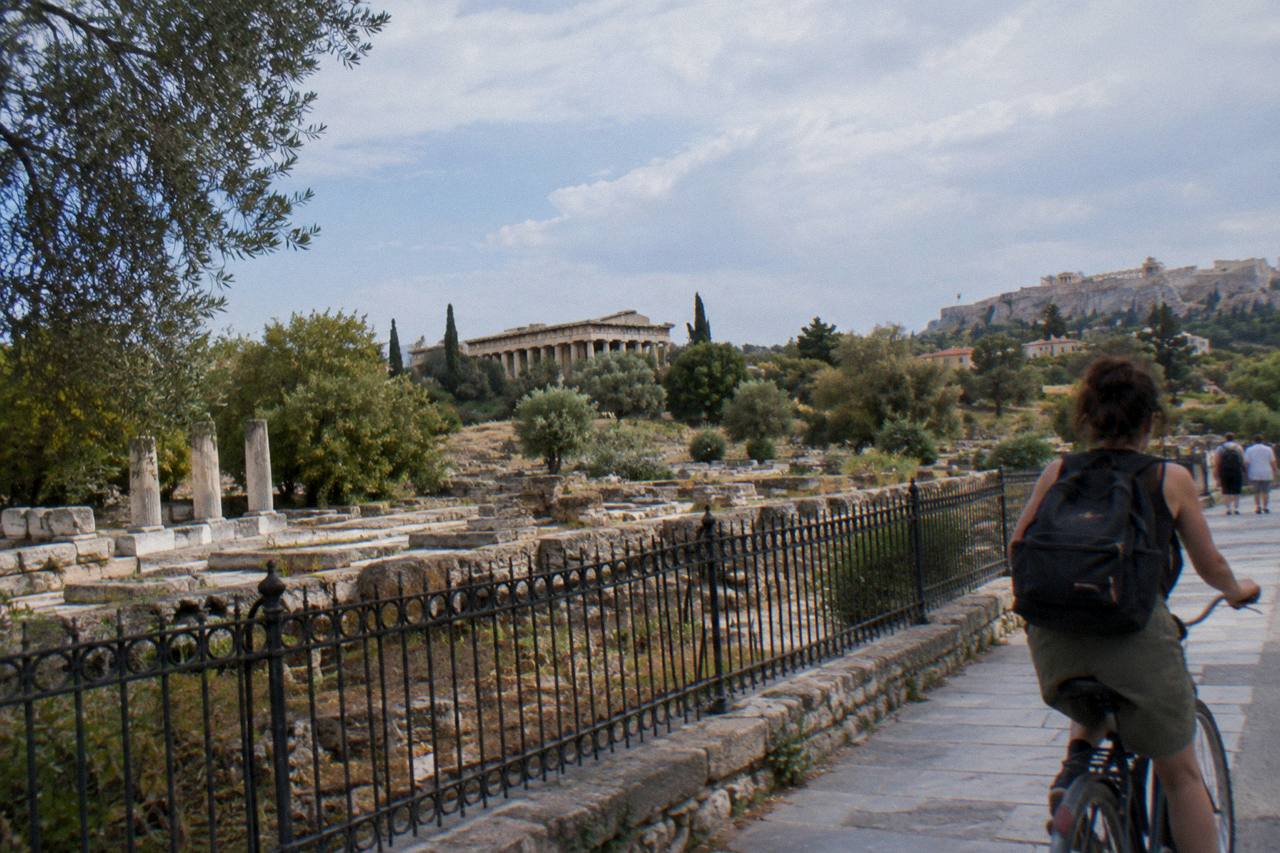
The site is not a single monument. It is a stretch of ground holding the foundations of stoas, law courts and civic buildings, with two standing structures that most visitors come specifically to see: the Hephaisteion, a Doric temple on the Kolonos Agoraios that is among the best-preserved temples of ancient Greece, and the Stoa of Attalos, a reconstructed colonnaded hall that now serves as the site museum. Between them lie the remains of buildings that carried the everyday business of the Athenian democracy: the Tholos where officials ate, the Metroon where state records were kept, and the courts themselves.
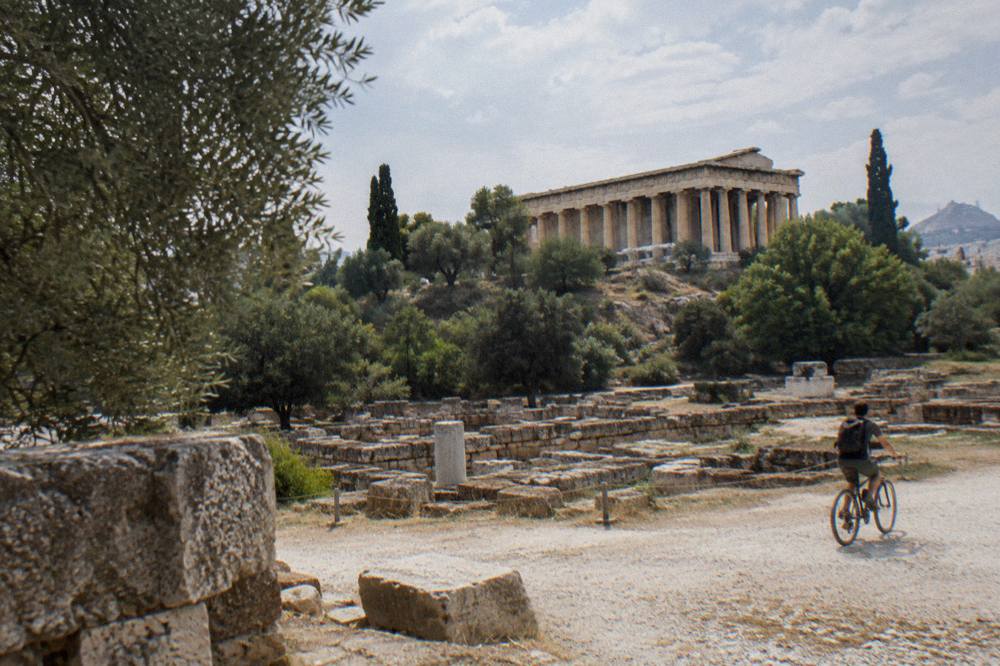
The position matters for cyclists more than for anyone else. The Agora sits on the flat ground northwest of the Acropolis, on the route that connects Monastiraki and Plaka with the Kerameikos area and the streets below the Areopagus hill. That line is exactly the corridor that historical-centre bike rides use, which is why the Agora appears on so many Athens itineraries without ever being the headline: riders pass along its edges on the way between the bigger sights. The historical centre ride guide on this site covers the tours that run this corridor, and a visit planned around one of them gets the Agora almost for free.
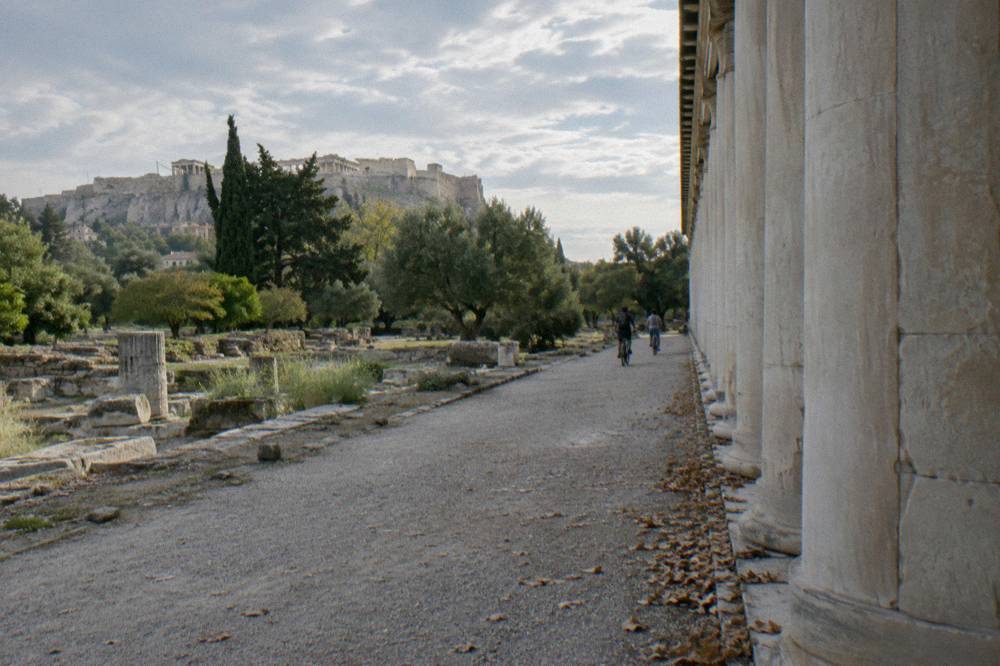
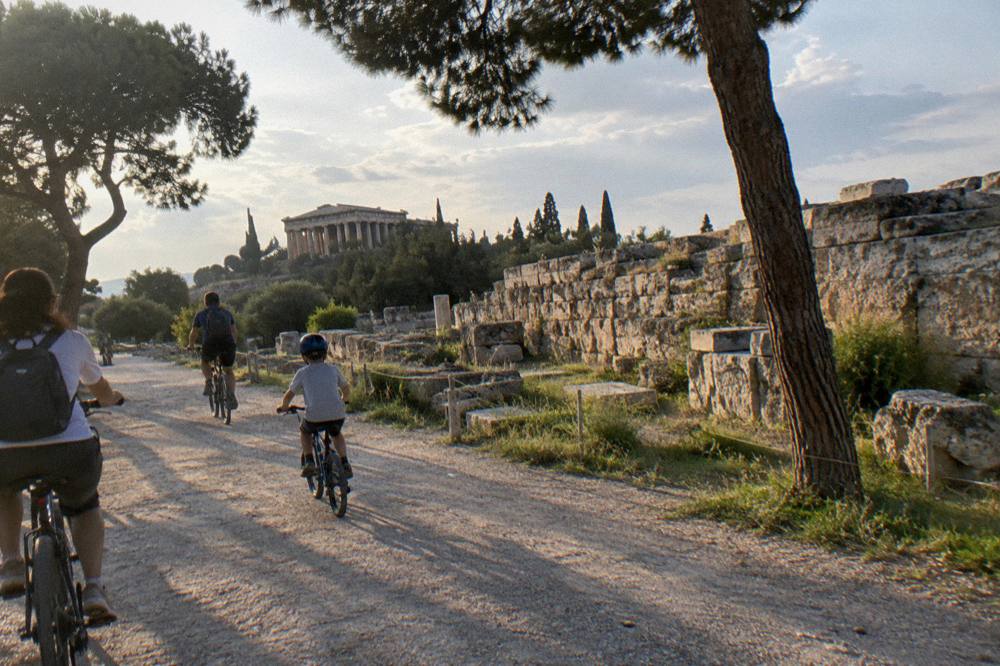
What you see at ground level rewards a slow pass. The Hephaisteion's colonnade still stands nearly complete on its hill, because the building spent centuries as a church and was never quarried to bare foundations. The Stoa of Attalos is a modern rebuilding on the ancient footprint, raised after the excavations as a museum building, and its ground-floor colonnade now displays sculpture and finds from the dig. The rest is lower: foundation lines, cut bedrock, and the stones of a district that was progressively buried and then dug back out.
How Much Time Do You Need At The Ancient Agora?
Most visitors spend between one and two hours inside the Agora itself, which covers the main axis from the Stoa of Attalos to the Hephaisteion plus the museum colonnade. Add another hour if a guided historical-centre ride shares the same day, since the rides run about 3 hours. Anyone pairing the Agora with the Acropolis should treat that as a full morning plus an afternoon.
The answer depends on what the Agora is being asked to do in the itinerary. As a walk-through, it is compact: the park is a single rectangle of ground, entered at its corners, with one museum building and one standing temple. A fast visitor can cross it in under half an hour. As a site read properly, with the museum and the temple and the foundation lines, it behaves like a two-hour visit.
The complication is the surrounding neighbourhood, not the site. The Agora sits directly against Monastiraki, Plaka and the streets of the historical centre, and almost nobody visits it in isolation. It arrives mid-walk, between Hadrian's Library and the Roman Agora on one side or on the route down from the Acropolis toward the Kerameikos on the other. Planning it as a stop inside a larger loop through the old town is what most itineraries actually do, and it is what the guided rides do too: the bike tours that cover the historical centre pass the Agora as a segment of a circuit that also takes in the Acropolis approaches, the old Ottoman-era lanes of Plaka, and the squares of Monastiraki.
For a rider, the timing question is really about sequencing. The Agora's ground is flat, open and unshaded in most of its extent, which makes it a hot midday stop in summer but an easy one in the morning. The Acropolis, by contrast, is a climb with queues. A day that does the Acropolis first, early, then descends into the Agora late morning, reads better than the reverse in every season, and the timed-entry system at the Acropolis makes an early start the safer bet.
These three rides are the ones this site rates for a first-time visitor who wants the historical-centre circuit that includes the Agora's neighbourhood:
Each runs on a small-group basis from a meeting point in the Acropolis district, each lists free cancellation, and each covers the flat streets of the old town where the Agora sits. Between them they span the formats worth knowing: the most reviewed ride on this site, a longer e-bike version that includes Acropolis entry tickets in its price, and a regular-bike circuit with light refreshments included.
Which Athens Rides Pass The Ancient Agora?
The rides that pass the Agora are the historical-centre circuits, all departing from meeting points in the Acropolis district: the Regular or E-Bike, Optional Acropolis ride from $40.12 per person, the Historical Centre Bike Ride from $45, and the E-Bike Tour, Acropolis Tickets Included from $79.09. Durations run from 2 hours 30 minutes to 4 hours 30 minutes on small groups, and each includes the bike and the guide.
The Agora sits on a natural through-route, and the tours that use it are the ones whose route description covers the historical centre as a whole. On this site's covered options, that means a specific set: the scenic regular-or-e-bike circuits from the Athens by bike meeting point at Athanasiou Diakou, the Historical Centre Bike Ride from Tzireon, and the longer Acropolis e-bike circuits that use the extra time to include the hill itself. Rides that head out to the coast, the Riviera or Hymettus do not pass it.
| Ride | Duration | From price per person | Rating and reviews | Group cap |
|---|---|---|---|---|
| Regular or E-Bike, Optional Acropolis | 2 hours 30 minutes | $40.12 | 5.0 across 3,666 reviews | 12 |
| Historical Centre Bike Ride | 3 hours | $45 | 4.9 across 97 reviews | 12 |
| E-Bike Tour, Acropolis Tickets Included | 4 hours 30 minutes | $79.09 | 5.0 across 741 reviews | 12 |
| Small Group, Optional Acropolis Stop | 2 hours 30 minutes | $33.24 | 5.0 across 1,264 reviews | 12 |
| E-Bike Hidden Gems and Highlights | 3 hours | $38 | 5.0 across 56 reviews | 12 |
The Regular or E-Bike, Optional Acropolis ride deserves the highlight because of its review pool: 3,666 reviews at a 5.0 average is the deepest pool of any ride covered here, and its from-price of $40.12 is low for a 2 hour 30 minute guided circuit. The listing describes an optional licensed-guide visit inside the Acropolis, with the Acropolis entry ticket not included in the from-price unless that option is selected at booking. Riders choose between a regular bike and an e-bike at booking, which matters for anyone unsure about the hills: the circuit keeps to gentler ground, but the approaches to the Acropolis viewpoints climb.
The Regular or E-Bike ride's page carries the full route description, and the price shown there depends on the options picked. Check availability
The Historical Centre Bike Ride, from $45 per person, is the regular-bike version of the same neighbourhood: 3 hours on a 12-rider cap with a helmet and a drink included, run by Active Athens Holidays from Tzireon, a short walk from the Acropolis. Its 97-review pool is smaller but consistently high at 4.9. It is the pick for a rider who wants the leg exercise of a non-electric bike over the same streets, and its listing notes the Acropolis and other entries are not in the price.
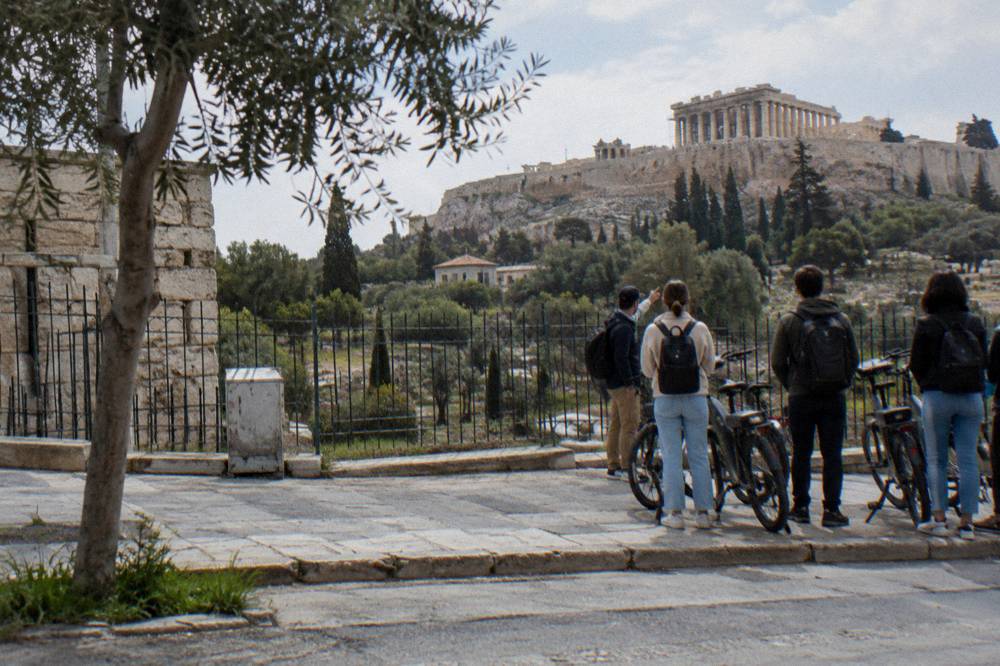
For a rider who wants the Acropolis itself inside the ride rather than as a separate expedition, the E-Bike Tour, Acropolis Tickets Included wraps the hill into a 4 hour 30 minute e-bike circuit at $79.09 per person, with the entry ticket in the price unless the booking is made without it.
For anyone comparing the two formats first, the e-bike versus regular bike comparison breaks down the hill question street by street, and the beginners guide covers what a first circuit in this district actually feels like at street level.
How Do Tickets And Entry To The Ancient Agora Work?
The Ancient Agora is a ticketed state archaeological site, and its entry conditions, prices and opening hours are published on the official e-ticket page for the Acropolis and archaeological sites, the only source a visitor should book from. This guide prints none of them, because state-site figures shift with season and restoration work. What holds steady: entry is paid, and the museum inside the Stoa of Attalos is included.
The practical workflow is simple. Check the current prices and hours on the official archaeological sites e-ticket page, decide between a single-site ticket and whichever combined option the page offers while you are there, and buy from that page or at the gate as your schedule requires. Anything a third party claims about prices should be checked against that page before money changes hands.
Two things are worth knowing before the ticket question even comes up. First, the Agora's layout: the fenced site has entrances at different corners, and the Stoa of Attalos museum sits at one end while the Hephaisteion stands at the other, so a visitor entering on the Monastiraki side and exiting at the other corner walks the whole site in one line, which is the natural route. Second, the surroundings: the modern streets around the Agora are the pedestrianised and semi-pedestrianised lanes of the historical centre, which is why the bike tours thread through here so easily. The where rides start guide maps the meeting points that sit within walking distance of this district.
Guided bike rides do not replace the entry decision. The rides that pass the Agora pass it as a route segment, viewing it from the surrounding streets, and the rides that enter the Acropolis list that inclusion explicitly, as the Optional Acropolis ride's listing describes. A visitor who wants to walk inside the Agora park itself should plan a separate slot, and should check the current entry figures on the official page the same week as the visit. Everything else covered here is indexed on Bike Tours Athens.
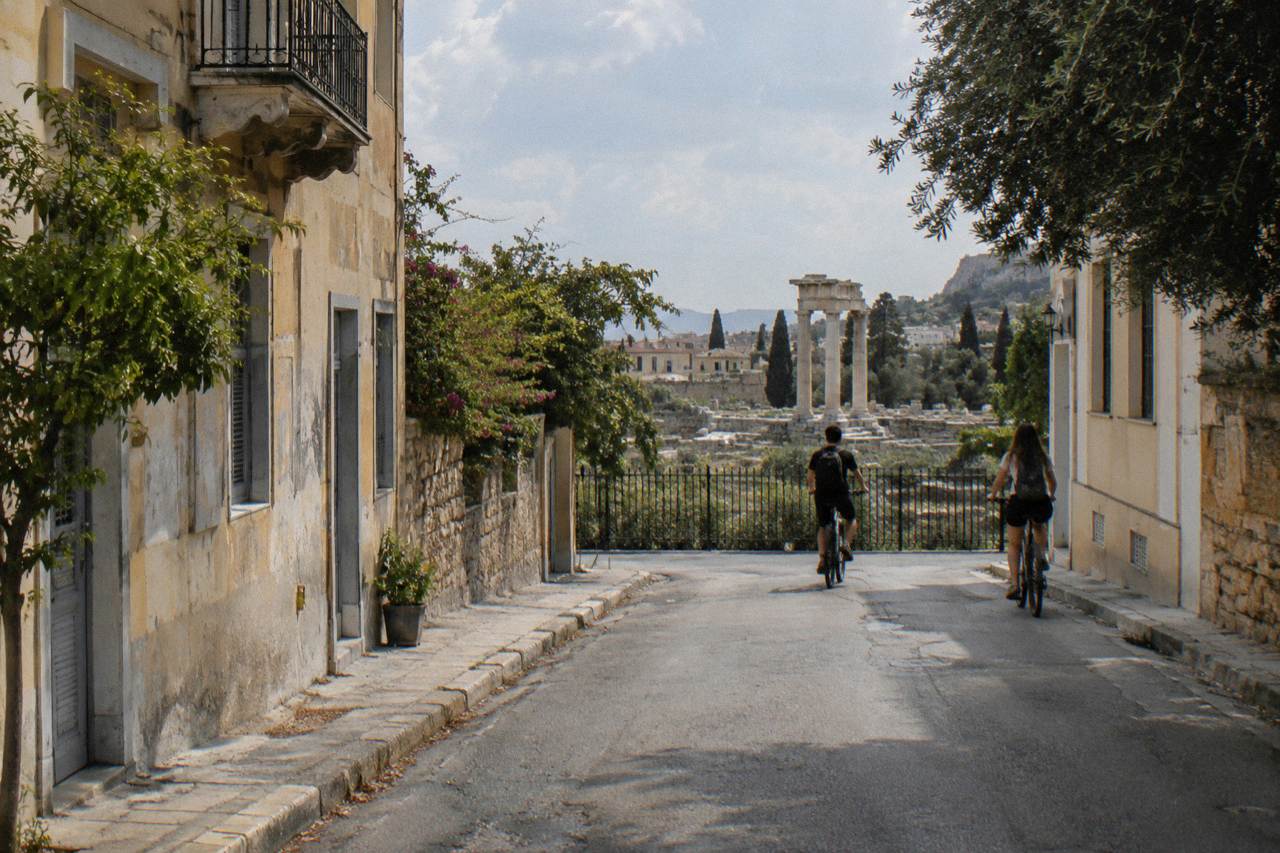
The one structural fact that helps planning: the archaeological sites of the historical centre cluster within a single walkable rectangle. The Agora, the Roman Agora, Hadrian's Library and the Acropolis all sit within a few minutes of each other on foot, which is why a morning plus an afternoon covers the set and why the bike tours can show the whole district in under three hours.
What Are The Cycling Rules Around The Ancient Agora?
The rules governing a rider near the Agora come from the Greek Road Traffic Code, Law 5209/2025, published in the Government Gazette (FEK A 100) on 13 June 2025: helmets recommended but not mandatory for bicycle and e-bike riders, riding two abreast banned, hand-held phones and headphones banned at a 350 EUR fine, and a duty to dismount and walk where pedestrians are endangered. On guided rides the guide carries this burden; independent riders carry it themselves.
- Riviera And Coast Rides$28.66
- E-Bike Tours$33.24
- Sunset And Night Rides$33.24
- City And Acropolis Rides$40.12
- Private And Day Trips$61.90
The historical centre around the Agora is exactly where these rules bite hardest, because it is the most pedestrian-dense district in the city. The lanes of Plaka and the streets around Monastiraki fill with foot traffic for most of the day and evening, and the road code's dismount rule, Article 44, is written for precisely this case: a cyclist in a crowd must get off and walk. Article 44 of the road code also requires riders under 12 to be accompanied by a person aged 16 or over on roads open to motor vehicles.
| Rule for riders | What the road code says | Fine |
|---|---|---|
| Riding two abreast | Prohibited | 30 EUR |
| Hand-held phone or smartwatch | Prohibited while riding | 350 EUR |
| Headphones | Prohibited while riding | 350 EUR |
| Dismount near pedestrians | Must get off and walk when endangering or obstructing | 30 EUR |
| Both hands on handlebar | Required except when signalling | 30 EUR |
| Red bicycle signal | Must not be run | 150 EUR |
| Helmet | Recommended for bicycles, mandatory only for e-scooter-type vehicles | Not fined for bicycles |
The helmet line is the one visitors most often get backwards. Under the 2025 code a helmet is recommended, not required, for bicycle riders and for e-bikes sold as bicycles, and the mandatory-helmet rule with its 30 EUR fine applies only to riders of e-scooter-type light personal electric vehicles. The guided rides on this site list helmets as included anyway, which is the sensible posture in Athens traffic regardless of what the law requires. Anyone wanting the full picture of conduct on Greek roads has it in the cycling rules guide.
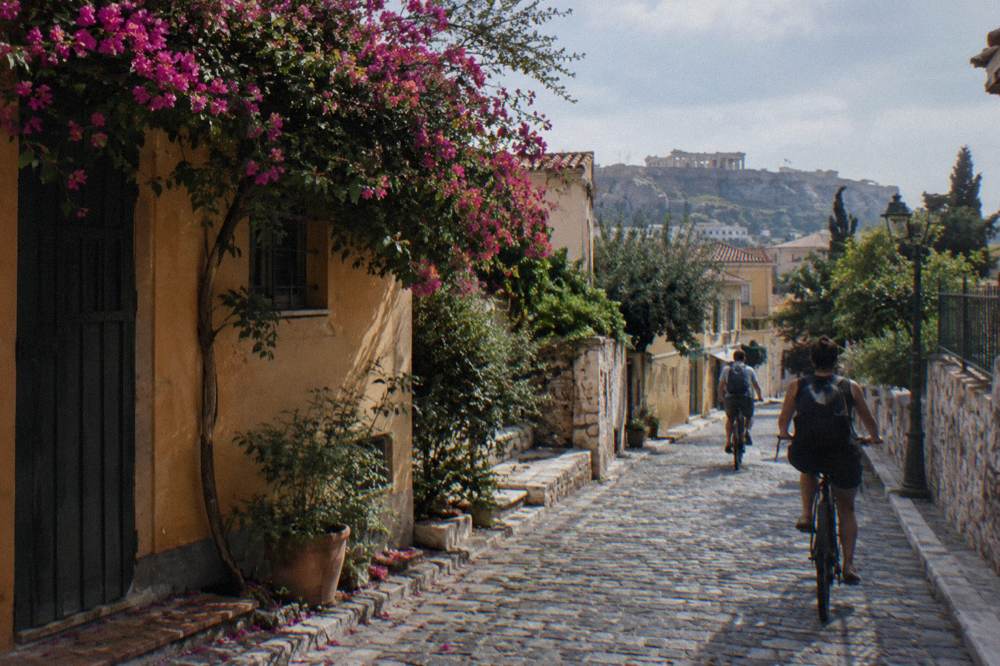
Inside the archaeological park itself, bikes do not belong: the Agora is a walk-only site, as state archaeological sites in the centre generally are, and the tours treat it accordingly, riding the perimeter streets and dismounting or passing by rather than cutting through. The riding around it happens on the connecting lanes, where the surface alternates between cobblestones, marble-flagged paving that is genuinely slippery when wet, and ordinary asphalt. Marble under a wet tyre is the single best argument for the morning ride slot in any season with rain.
For families, the under-12 accompaniment rule matters: a child rider on the district's open-to-cars lanes needs a rider aged 16 or over alongside, and the family-oriented circuits are covered in the kids guide.
When Is The Best Season To Visit The Ancient Agora?
The best time to visit the Ancient Agora is April to June or September to October, when conditions in Athens are mild, typically 15 to 25 C by day, with less rain than winter and fewer crowds than peak summer; July and August often exceed 35 C, and while November stays mild at around 15.4 C, it is one of the wettest months, with roughly 50 to 70 mm of rain over 10 or more rainy days.
The seasonal logic for the Agora is heat, not rain. The site is an open, largely unshaded rectangle, and the historical-centre rides run through the same exposed streets. In July and August a midday visit is a hot one, and the one verified heat-closure case on record shows how this ends elsewhere on the district's sites: the Ministry closed the Acropolis from 1 p.m. to 5 p.m. on 8 and 9 July 2025, near 40 C, a documented instance of afternoon closures happening in extreme heat rather than a promise that they will.
| Month | Mean C | Max C mean | Precip mm | Rain days | Verdict for the Agora district |
|---|---|---|---|---|---|
| March | 12.4 | 15.9 | 42.3 | 11.3 | Cool, reliable, thin crowds |
| April | 16.1 | 19.6 | 25.5 | 9.3 | Excellent |
| May | 20.9 | 24.4 | 14.3 | 6.4 | Excellent |
| June | 25.6 | 29.2 | 5.4 | 3.6 | Excellent |
| July | 28.3 | 32.2 | 6.3 | 1.7 | Hot, ride early |
| August | 28.2 | 32.2 | 6.2 | 1.6 | Hot, ride early |
| September | 24.3 | 28.3 | 12.3 | 4.7 | Excellent |
| October | 19.6 | 23.4 | 45.9 | 8.6 | Excellent, some rain |
| November | 15.4 | 18.8 | 60.1 | 10.9 | Mild, wettest early-winter month |
Summer visits are not banned, they are restructured. The sunset and night rides exist for exactly this: the Sunset Ride, Regular or E-Bike runs 2 hours 30 minutes from $33.24 per person with a 5.0 rating across 169 reviews, and the 2-Hour Night Highlights E-Bike runs from $54 with a 4.9 across 580 reviews. Both shift the exertion out of the afternoon entirely, and both pass through the historical centre after the day's heat has dropped. The trade is that neither shows the archaeological interiors in daylight, which is the point of an Agora visit, so the serious summer answer is a morning ride plus a morning walk of the site, with the afternoon surrendered.
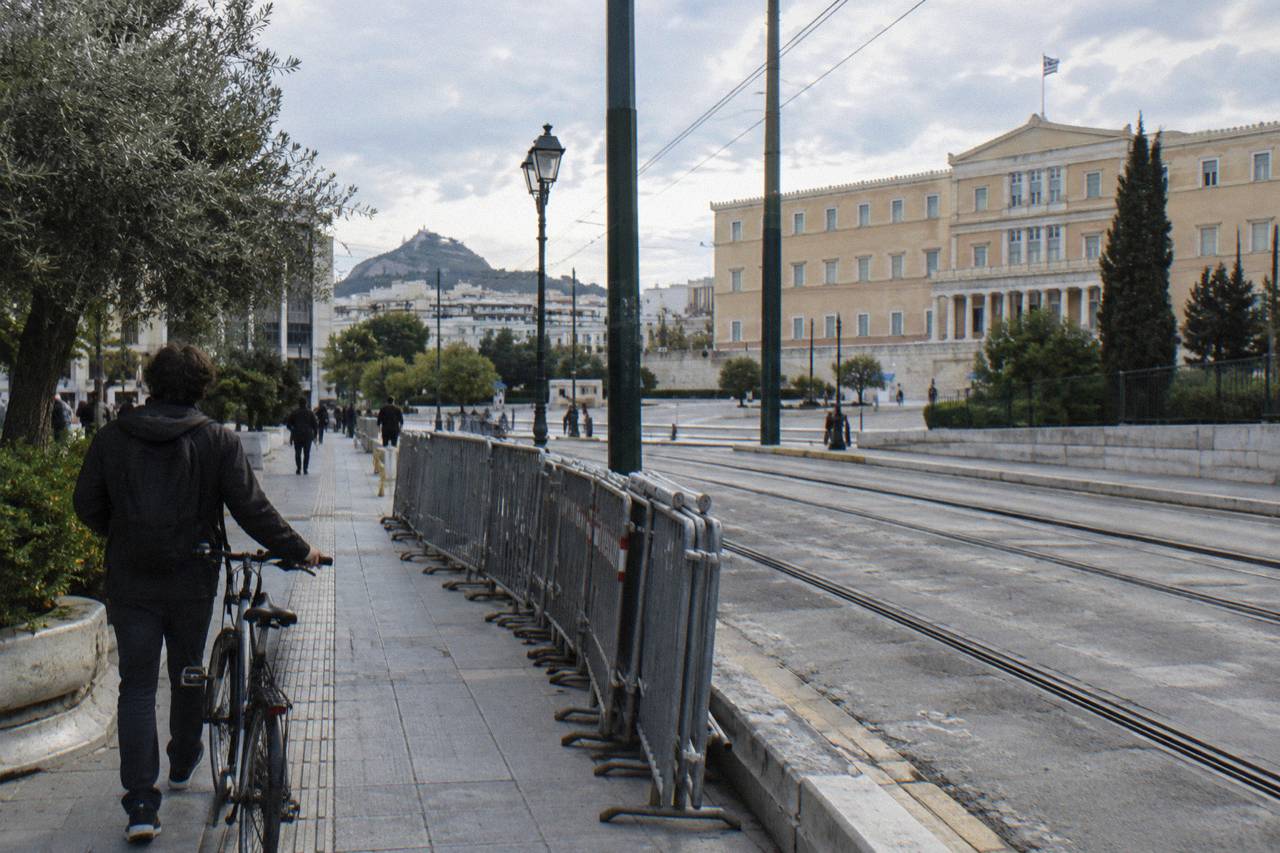
One dated event belongs on any early-November itinerary: the 43rd Athens Authentic Marathon runs on 7 and 8 November 2026, with the marathon and 10 km on Sunday 8 November and the shorter races on Saturday 7 November. Closures for all vehicles, bicycles included, hit Irodou Attikou and Vas. Georgiou B from Thursday 5 to Monday 9 November, with Vas. Konstantinou, Arditou and M. Mousourou shut from Friday afternoon to Sunday night. Marathon and 10 km fall on Sunday 8 November; the shorter races run Saturday. A historical-centre ride booked for that weekend may be rerouted or rescheduled, and the marathon's official site carries the race-day detail. Beyond that weekend, early November remains one of the better slots in the calendar: mild, cheap, and uncrowded compared with spring.
What Else Sits Near The Ancient Agora On Two Wheels?
Within a short ride of the Agora sit the Roman Agora and Hadrian's Library to the east, the Kerameikos area to the west, the Areopagus hill and the Acropolis approaches to the south, and the lanes of Plaka climbing the Acropolis slope, all inside the same walkable rectangle of the historical centre. None of these needs a bike inside it, but the connectors between them are exactly the streets the historical-centre rides use.
The practical way to think about the district is as a loop. A rider leaving the Monastiraki side passes Hadrian's Library and the Roman Agora, cuts along the Agora's fenced northern edge toward the Kerameikos, returns along the southern line below the Areopagus, and finishes through Plaka toward the Acropolis approaches. The tourist highlights inside that loop are covered in depth on the things to do guide, and the old-town specifics on the Plaka guide.
The one detour worth riding rather than walking is upward. Lycabettus Hill stands above the historical centre, reachable by a steeper climb than the Acropolis approaches, and the Athens hills by bike guide covers how the e-bike rides handle it. The historical-centre circuits mostly skip it, keeping to the flat, which is a reasonable trade for a first visit and a reason to book a longer or private ride on a second.
Getting to the Agora by transit with a bike follows the standard rules: the metro's last door takes up to two bicycles with elevators required at stations, while buses accept only folding bikes in a holder of at most 33x66x80 cm, per the OASA passenger regulation. Most guided rides remove the question entirely by starting from meeting points inside the historical centre, a short walk from the district, so the transit rules matter mainly to riders bringing their own bikes in from further out. The metro guide covers station access in detail.
Priced as a standalone afternoon, the e-bike alternatives that reach beyond the old town start low: the Small Group, Optional Acropolis Stop ride at from $33.24 per person for 2 hours 30 minutes is tied for the lowest from-price among rides with a review pool above 15, matching the Sunset Ride, at a 5.0 across 1,264 reviews. That is the budget benchmark, and everything longer or more specialised climbs from it.
For riders who want the district with a private guide, the Private Electric Bike, 3 Hours ride runs from $80.23 per person with the total depending on group size, at a 5.0 across 187 reviews, and the booking page carries the per-group pricing.
Common Questions About The Ancient Agora
What Is The Ancient Agora Of Athens?
The Ancient Agora was the civic centre of classical Athens: law courts, assemblies, markets and public buildings on the flat ground below the Acropolis. Its best-preserved monuments are the Hephaisteion temple and the reconstructed Stoa of Attalos, which holds the site museum.
Do Athens Bike Tours Stop Inside The Ancient Agora?
No. The historical-centre rides pass the Agora's perimeter streets as a route segment, but the archaeological park itself is a walk-only site. Rides that include an entry inside the Acropolis list that inclusion explicitly, as the Optional Acropolis ride's listing does, and the Agora is not part of it.
Which Ride Passes The Agora For Under $45?
The Regular or E-Bike, Optional Acropolis circuit runs from $40.12 per person for 2 hours 30 minutes, with a 5.0 rating across 3,666 reviews, and the Historical Centre Bike Ride runs from $45 for 3 hours at a 4.9 across 97 reviews. Both cover the historical-centre streets around the Agora on small groups capped at 12.
Is Cycling Allowed In The Streets Around The Ancient Agora?
Yes, on the surrounding lanes, subject to the Greek road code. Helmets are recommended rather than mandatory for bikes and e-bikes, riding two abreast is banned, and riders must dismount and walk where pedestrians are obstructed or endangered, which in the Monastiraki and Plaka lanes is often.
When Is The Best Time Of Day To Visit The Ancient Agora?
Morning, in every season. July and August mean temperatures sit at 28.3 and 28.2 C at Elliniko, with maxima near 32.2 C and central Athens running warmer by day, and the site is largely unshaded. The one documented pattern in extreme heat is afternoon closures of the Acropolis, seen on 8 and 9 July 2025, so an early start protects the visit against both.