Cycling Rules In Greece: Helmets, Lights And Road Etiquette
Greece replaced its old traffic code in 2025 with Law 5209/2025, and the new rules give cyclists their own articles, their own fines and their own obligations. Here is what the law actually says, which fines cost the most, and what it means for riding in Athens.
Short answer
Helmets are recommended, not mandatory, for bicycle and e-bike riders under Article 44 of Law 5209/2025. Riding two abreast, holding a phone and wearing headphones are banned, with fines from 30 to 350 EUR. A red bicycle signal costs 150 EUR. Children under 12 must ride with someone aged 16 or over on motor roads.
Greece rewrote its road traffic rules with Law 5209/2025, published in the Government Gazette on 13 June 2025, replacing decades of amendments to the old code. Cyclists got their own treatment in the new law: dedicated provisions in Article 44, an equipment standard in Article 80, and a published table of fines from the Ministry of Infrastructure and Transport. The short version is that riding a bicycle in Athens is legal, common and increasingly catered for, but it comes with specific obligations that did not exist in the same form before. To stay on the right side of those new obligations, our guide to the mistakes cyclists make in Athens covers the habits and fines that matter most.
This page walks through the rules as the law states them, not as rumour repeats them. The helmet question gets answered precisely, because the law is more nuanced than most blog posts claim. The fine amounts come from the Ministry's published penalty table. And because most visitors meet Greek cycling law through a guided ride rather than a solo rental, the later sections connect the legal picture back to what a tour operator handles for you, with the tour details taken from the options covered on Bike Tours Athens.
What Are The Main Cycling Rules In Greece?
Greek traffic law treats bicycles as road vehicles with their own rule set in Article 44 of Law 5209/2025: ride in the direction of traffic, keep both hands on the handlebar except when signalling, never ride two abreast, never hold a phone or wear headphones, dismount where pedestrians are endangered, and use a cycle lane wherever one exists. Fines for violations run from 30 EUR to 350 EUR.

The 2025 law consolidated cycling into a coherent set of obligations rather than scattering them across decades of amendments. Article 44 is the core: it sets where cyclists may ride, how they must behave around pedestrians and cars, and which devices they may not touch while moving. Article 80 sets the equipment standard, covering lights and reflectors for riding after dark. Article 46 covers alcohol, and unlike some countries, Greece sets no cyclist-specific blood alcohol threshold: the 0.50 g/l blood and 0.25 mg/l breath limits apply to every road vehicle, bicycles included.
Two of the newer rules carry the heaviest penalties and deserve emphasis. Holding a phone or a smartwatch-type device while riding draws a 350 EUR fine, the same as wearing headphones connected to an audio device. Both are category E3-B violations in the Ministry's penalty table. Running a red bicycle signal costs 150 EUR. Most other cycling violations sit at 30 EUR.
For a visitor, the practical reading is straightforward. Ride predictably, follow the signals, keep the phone in a pocket, and the law is largely on your side. The text of Article 44 sets out all of it, and the sections below unpack each rule in the order a rider actually meets it.
| Rule | What the law says | Fine |
|---|---|---|
| Helmet (bicycle) | Recommended, not mandatory | None |
| Helmet (e-scooter type, EPMV) | Mandatory | 30 EUR |
| Two abreast | Prohibited | 30 EUR |
| Phone or smartwatch in hand | Prohibited while riding | 350 EUR |
| Headphones | Prohibited while riding | 350 EUR |
| Red bicycle signal | Must stop | 150 EUR |
| Both hands on handlebar | Required except when signalling | 30 EUR |
| Hand signals | Required if no indicators | 30 EUR |
Do You Have To Wear A Helmet On A Bike In Athens?
No. Article 44 of Law 5209/2025 says bicycle riders are recommended to wear an approved-type protective helmet, not required to. The mandatory helmet rule applies only to riders of EPMV, the e-scooter class of light personal electric vehicle, where riding without one draws a 30 EUR fine. An e-bike sold as a bicycle falls under the recommended rule.
This is the single most repeated inaccuracy in English-language coverage of Greek cycling. The law draws a hard line between two categories. A conventional bicycle, and an electric bicycle that the law treats as a bicycle, gets a recommendation in Article 44, section 12. A light personal electric vehicle of the e-scooter type, abbreviated EPMV in the Greek text, gets a requirement in the same section, with the fine set at 30 EUR in the Ministry's table.
The distinction matters because Athens tour operators overwhelmingly ride pedal-assist e-bikes, which sit on the bicycle side of the line. Every tour on this site that lists a helmet lists it as an inclusion in the price, not a legal obligation. That is worth understanding correctly for two reasons. First, a rider who knows helmets are optional can make an informed choice rather than a fearful one. Second, a rider who knows the law will not be confused when a guide hands out helmets anyway, because operators supply them as a safety standard rather than a legal requirement.
The practical advice does not change much regardless of the statute. The historic centre of Athens mixes cobblestones, smooth marble paving, tram tracks and dense traffic, and a helmet is cheap insurance on all four. The rules in this article tell you what the law demands; wearing one anyway is simply good practice on a city ride.

What Equipment Does Greek Law Require On A Bicycle?
Article 80 of Law 5209/2025 requires one white or yellow front light, one red rear light or reflector, at least one reflector on each side, and a yellow reflector on each pedal. Racing bikes, mountain bikes and small-wheeled bicycles up to 500 mm wheel diameter are exempt from the reflector rules when not ridden at night. The equipment violation fine is 30 EUR.
The equipment standard is written for riding after dark, and the exemption list shows the lawmakers thinking about which bikes actually carry lights. Racing and mountain bikes, which often have no mounting point for pedal reflectors, are exempt from the reflector clause unless ridden at night. The lights requirement itself applies whenever the bike is on the road in conditions requiring illumination.
For a rider joining a tour, this is handled before arrival. Every e-bike tour on this site lists the bicycle as included, and the question of lights belongs to whoever maintains the fleet. For a rider renting on their own, the Athens bike rental guide covers what a rental contract should include, and the equipment clauses in Article 80 are the baseline to check against: front light on, rear reflector present, side reflectors present.
The text of Article 80 is short and worth a skim even for casual riders, because the fine is written into the same category as most minor cycling violations. A 30 EUR penalty for a missing rear light is a real cost on top of an avoidable safety problem.
What Fines Apply To Cyclists Under The Greek Road Code?
The Ministry of Infrastructure and Transport's published penalty table sets most minor cycling violations at 30 EUR: riding two abreast, missing lights or reflectors, one hand off the handlebar, missing hand signals, and failing to dismount where pedestrians are endangered. Holding a phone or wearing headphones costs 350 EUR, and running a red bicycle signal costs 150 EUR.
The fine structure follows the danger rather than the vehicle. Violations that merely inconvenience or complicate traffic sit at 30 EUR. Violations that put the rider or others at immediate risk sit far higher. The phone and headphone rules, both at 350 EUR, are treated as seriously as they are because a distracted cyclist in dense Athens traffic is a hazard to pedestrians as much as to themselves.
| Violation | Category | Fine |
|---|---|---|
| Riding two or more side by side | E1-A | 30 EUR |
| Missing lights or reflectors | E1-A | 30 EUR |
| One hand off the handlebar (not signalling) | E1-A | 30 EUR |
| No hand signal when required | E1-A | 30 EUR |
| Not dismounting where pedestrians are endangered | E1-A | 30 EUR |
| Child under 12 riding unaccompanied on a motor road | E1-A | 30 EUR |
| Helmet missing on an EPMV rider | E1-A | 30 EUR |
| Phone or smartwatch in hand while riding | E3-B | 350 EUR |
| Headphones connected to an audio device | E3-B | 350 EUR |
| Running a red bicycle signal | E2-A | 150 EUR |
The full Ministry penalty table runs to 50 pages and covers every category of road user. The cycling rows are a small fraction of it, but they are the fraction a visitor on two wheels should know. Alcohol deserves a separate note: Article 46 sets no cyclist-specific threshold, applying the standard impairment limits of 0.50 g/l blood or 0.25 mg/l breath to every road vehicle. A rider who would not drive after wine should not ride either.
Can You Ride Two Abreast Or On Sidewalks In Athens?
Riding two or more bicycles side by side is prohibited outright under Article 44, with a 30 EUR fine. Sidewalk riding has no general permission in the law: the stated rule is that cyclists must dismount and walk whenever they obstruct or endanger pedestrians, a 30 EUR violation. Where a cycle lane exists, cyclists must use it.
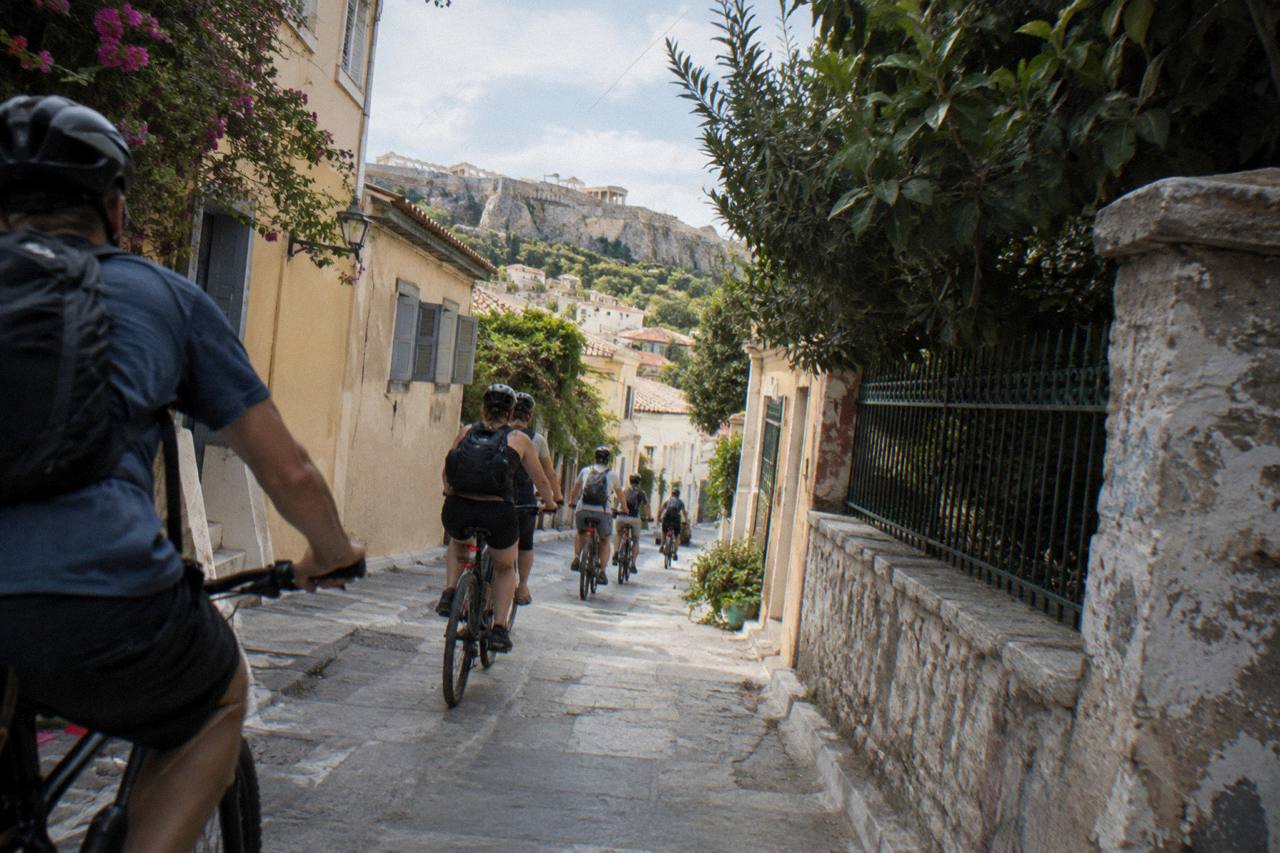
The two-abreast ban is one of the older rules carried into the new code, and it changes how a group ride physically works. On a guided tour, the guide marshals the group into single file on narrow stretches, and riders who understand why tend to hold the line better. On a solo ride, pairs of cyclists need to rotate the lead position rather than ride in conversation.
The sidewalk question is where the law is most commonly misread. Article 44 does not ban sidewalk riding in a single sentence, and it does not permit it either. What it states is an obligation to dismount and walk when the rider obstructs or endangers pedestrians, and the Ministry table prices failing to do so at 30 EUR. In practice, on a busy Athens sidewalk, a moving bicycle endangers pedestrians and the obligation engages. There is also a counterintuitive companion rule: pedestrians may use cycle roads across their full width and must give way to bicycles there, so the courtesy obligations run in both directions.
The cycle-lane rule completes the picture. Where a marked lane exists on a road, Article 44 section 5 directs cyclists to it rather than the rest of the carriageway. Athens has painted lanes on several central and coastal streets, and using them is both the legal default and the safer choice.

The safest-riding question gets a longer treatment on the is cycling in Athens safe guide, which covers traffic behaviour, road surfaces and the areas where caution matters most.
What Are The Rules For Children Cycling In Greece?
Article 44 requires a child under 12 riding on a road open to motor vehicles to be accompanied by a person aged 16 or over, with a 30 EUR fine for non-compliance. Carrying a passenger on a bicycle is banned except for one passenger on a bicycle built with two pedal sets and a fixed extra seat, or a child in an approved non-permanent seat.
The child accompaniment rule is specific about where it applies. It covers roads open to motor vehicles, which is the legal phrase for ordinary streets. A child riding in a park or on a cycle path is not covered by the accompaniment obligation in the same terms, though the general traffic rules still apply everywhere.
The passenger rules are stricter than in many countries. Adult passengers are prohibited unless the bicycle is purpose-built with two pedal sets and a fixed second seat. Children and infants may be carried in a special non-permanent seat of the child-seat type. In practice this means a cargo-bike-style setup or a rear child seat is lawful, and a friend perched on the rack is not.
No minimum age, weight limit or fitness grading appears in the tour information available here, so families should raise those questions directly with operators before booking. The family-focused Athens bike tour with kids guide covers the practical side of riding with children in the city, from e-bike options to which tour types suit younger riders.
Can You Take A Bike On Athens Public Transport?
The OASA passenger regulation allows up to two bicycles in the last door of each metro train, carried by the rider, who must use elevators and not escalators. Buses and trolleybuses accept only folding bicycles in a carrying holder of at most 33x66x80 cm. Hellenic Train carries up to four conventional bicycles free on the Athens-Chalkida, Piraeus-Airport and Piraeus-Kiato suburban services.
The metro rule is the one that surprises visitors most, because Athens' system is unusually bike-friendly by the standard of southern European capitals. The condition attached is logistics: the bike travels in the last door of the train, and the rider uses the lifts, not the escalators, to move between street and platform. At busy hours a bicycle in a train car is a courtesy question as much as a regulation, and staff can refuse bikes when crowding makes carrying them unsafe.
| Service | Bicycle policy |
|---|---|
| Athens metro | Up to two bicycles in the last door of each train, use elevators |
| Buses and trolleybuses | Folding bikes only, in a holder of at most 33x66x80 cm |
| Athens-Chalkida, Piraeus-Airport, Piraeus-Kiato trains | Up to four conventional bicycles free, carriages 2 and 4 |
| Kiato-Aigio, Tavros-Kiato, Paiania-Ano Liosia trains | Up to two per carriage |
| Long-distance trains with luggage van | 5 EUR per bicycle at station ticket offices |
The OASA passenger regulation states the metro and bus rules in full, and the Hellenic Train bicycle transport page covers the rail side, including the 5 EUR charge on long-distance services with a luggage van and the requirement of a valid passenger ticket. Fare details for getting around the network are summarised on the how to get around Athens guide.
Do Guided Tours Handle The Rules For You?
A guided ride shifts the legal workload: the operator supplies a legal bicycle with lights and reflectors, a helmet as an inclusion, and a guide who manages lane choice, group order and traffic calls. The rider keeps personal obligations such as the phone ban, the headphone ban and single-file riding, but equipment and route legality are the operator's responsibility.

This is the strongest practical argument for a guided ride over a solo rental, and it is not a marketing point but a division of labour that follows directly from the law. Article 80's equipment standard is met by whoever maintains the fleet. Article 44's positioning rules are executed minute by minute by whoever leads the ride. A rider on a guided tour still cannot legally hold a phone while moving, still cannot wear headphones, and still must dismount where pedestrians are endangered, but the judgement calls about where those obligations engage are being made by a professional.
| Tour | Operator | Duration | Bike type | Helmet | From price |
|---|---|---|---|---|---|
| Regular or E-Bike, Optional Acropolis | Athens by bike | 2 hours 30 minutes | Rider chooses | Included | From $40.12 |
| Historical Centre Bike Ride | Active Athens Holidays | 3 hours | Regular | Included | From $45 |
| Historic E-Bike, 1.5 to 2.5 Hours | We Bike Athens | 1.5 to 2.5 hours | E-bike | Included | From $50 |
| E-Bike Hidden Gems and Highlights | BlueBike | 3 hours | E-bike | Not stated | From $38 |
| City Ride, Greek Treat Included | electricityrides | 3 hours | E-bike | Not stated | From $51 |
The Regular or E-Bike, Optional Acropolis ride is the most reviewed option in the city at 5.0 across 3,666 reviews, from $40.12 per person, with the bike and helmet included and a licensed-guide Acropolis visit available as an option. It is a good illustration of the guided model: 2 hours 30 minutes, a group capped at 12, and a guide who decides where the single-file stretches are. Check availability
Where Do The Athens Bike Rides Start From?
Every guided ride covered here starts in central Athens, with meeting points clustered in the Makrygianni, Thiseio, Koukaki, Petralona and Syntagma areas: Athanasiou Diakou 16, Apostolou Pavlou 53, Erisichthonos 54, Praxitelous 22, Dragatsaniou 6 and Thessalonikis 172 among them, plus Vergoti Square in Glyfada for the coastal departures. One coastal option departs from Vergoti Square in Glyfada. No tour listed here includes hotel pickup.
The meeting-point pattern follows the geography of the historic centre. The Athens by bike tours leave from Athanasiou Diakou 16, a short distance from the Acropolis Museum side of the hill. The We Bike Athens and MTM Experiences rides leave from Apostolou Pavlou 53 on the pedestrianised walkway below the Acropolis. The Blue Bike Athens and BlueBike options use Dragatsaniou 6 near Syntagma. Each point is reachable on foot or by metro from most central hotels, and the where Athens bike tours start guide maps the full set.
No tour on this site includes hotel pickup, which is worth stating plainly because many visitors assume it. The meeting time is on the booking page, and arriving a few minutes early is standard practice for a fitting and a briefing before the wheels turn.

How Does Athens Weather Affect The Rules?
The rules do not change with the season, but enforcement conditions do: HNMS climate normals for the Elliniko coastal station put July and August means at 28.3 and 28.2 C with maxima near 32.2 C and under two rain days, while November averages 15.4 C with 60.1 mm of rain over 10.9 days. Central Athens runs warmer by day than the coastal station.
Heat is the practical variable, not the legal one. In the one verified recent case, the Ministry of Culture closed the Acropolis from 1 p.m. to 5 p.m. on 8 and 9 July 2025 during a period near 40 C, a decision that also stops outdoor manual work in the hottest regions. Afternoon closures of that kind happen in heat, so a rider booking July or August should expect the hottest stretch of the day to be the least comfortable for riding.
Rain barely features from May through September, with July averaging 1.7 rain days and August 1.6. From October onward the picture turns: November is the wettest month in the first half of the cold season and December wetter still at 62.0 mm over 13.5 days. Wet marble is the hazard that matters in those months, because polished stone paving in the historic centre becomes slippery under thin tyres, and the dismount rule for pedestrian safety engages quickly in a crowded slick street.
The Athens weather by month guide carries the full climate table and the seasonal advice that follows from it, and the cycling in Athens summer heat guide covers morning-versus-evening planning in detail.

- Riviera And Coast Rides$28.66
- E-Bike Tours$33.24
- Sunset And Night Rides$33.24
- City And Acropolis Rides$40.12
- Private And Day Trips$61.90
Which Athens Ride Suits Each Type Of Rider?
For a rider who wants the law handled end to end, the choice comes down to group size and review pool. The Small Group, Optional Acropolis Stop caps at 12 riders from $33.24 per person; the Historic E-Bike option carries up to 20 from $50, rated 4.9 across 1,474 reviews; the most reviewed ride in the city is the Regular or E-Bike option at 5.0 across 3,666 reviews.
The trade-off worth naming is group size against attention. A cap of 20 on the busiest e-bike ride means more riders per guide but a lower per-person price; a cap of 12 means more room for individual coaching, which matters for a rider who is nervous in traffic. Private options remove the group question entirely: the Private Electric Bike, 3 Hours tour runs from $80.23 per person with the total depending on group size, rated 5.0 across 187 reviews.
| Rider profile | Best-fit option | Duration | From price |
|---|---|---|---|
| First-time city rider | Small Group, Optional Acropolis Stop | 2 hours 30 minutes | From $33.24 |
| Short on time | 2-Hour Night Highlights E-Bike | 2 hours | From $54 |
| Acropolis included in the price | E-Bike Tour, Acropolis Tickets Included | 4 hours 30 minutes | From $79.09 |
| Family or couple privacy | Private Electric Bike, 3 Hours | 3 hours | From $80.23 |
| Sea air and a swim | Coastal Ride, Swimming Stop | 3 hours 30 minutes | From $56.16 |
Every option in the table lists free cancellation on its booking page, and none includes hotel pickup, so the meeting-point plan matters as much as the route choice. Riders comparing the electric and pedal options should read the electric bike versus regular bike comparison before deciding, since the law treats both as bicycles and the choice comes down to hills and legs rather than rules.
Common Questions About Cycling Rules In Greece
Is It Legal To Ride A Bike Without A Helmet In Greece?
Yes. Article 44 of Law 5209/2025 recommends, rather than requires, an approved helmet for bicycle riders. The mandatory helmet rule applies to riders of EPMV light personal electric vehicles of the e-scooter type, with a 30 EUR fine for riding one without.
Can You Cycle On The Sidewalk In Athens?
The law gives no general permission for sidewalk riding. Article 44 requires cyclists to dismount and walk whenever they obstruct or endanger pedestrians, which on a busy Athens sidewalk means walking the bike. A 30 EUR fine applies for failing to dismount.
What Is The Fine For Using A Phone While Cycling In Greece?
350 EUR for holding a phone or smartwatch-type device while riding, the same amount as wearing headphones connected to an audio device. Both are among the highest cycling penalties in the Ministry's published table, above the 150 EUR fine for running a red bicycle signal.
Can You Take A Bike On The Athens Metro?
Yes, up to two bicycles travel in the last door of each metro train, carried by the rider, who must use elevators and not escalators. Buses and trolleybuses accept only folding bicycles in a carrying holder of at most 33x66x80 cm.
Do Children Need An Adult To Cycle In Greece?
A child under 12 riding on a road open to motor vehicles must be accompanied by a person aged 16 or over, with a 30 EUR fine for non-compliance. Carrying a child passenger is lawful only in an approved non-permanent child seat or on a bicycle built with two pedal sets and a fixed extra seat.
Are E-Bikes Treated The Same As Bicycles Under Greek Law?
An e-bike sold as a bicycle is treated as a bicycle, so the helmet recommendation rather than the mandatory rule applies to it. E-scooter type vehicles of the EPMV class are a separate category with their own requirements, including the mandatory helmet. All the road rules in Article 44 apply to both.