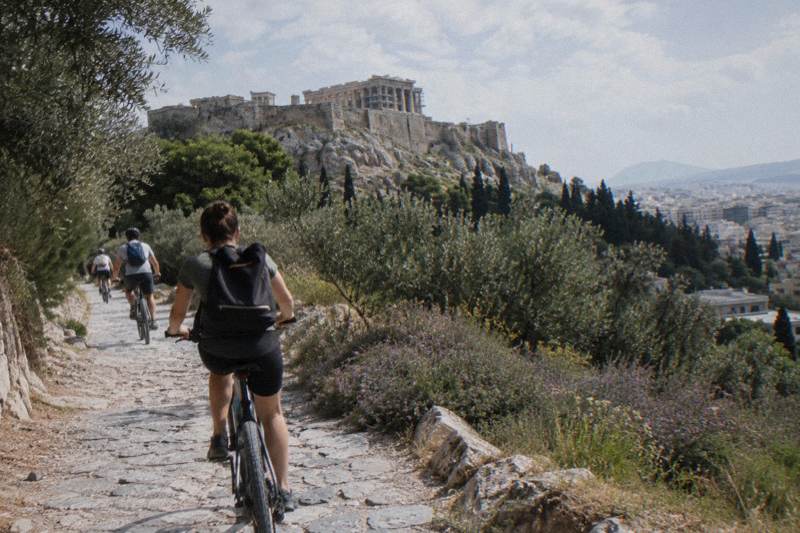
Things To Do In Athens For First-Time Visitors
Athens rewards a plan. The landmarks cluster tightly around the Acropolis, the sea is a short ride away, and a guided bike tour is one of the fastest ways to connect them all.
Short answer
First-time visitors should plan two or three days: the Acropolis and Plaka, the Ancient Agora, and a hill or coastal view. A 2 hour 30 minute scenic bike tour from $40.12 per person covers the historic centre, while a sunset ride from $33.24 adds evening light, and a Riviera trip reaches Glyfada and Voula.
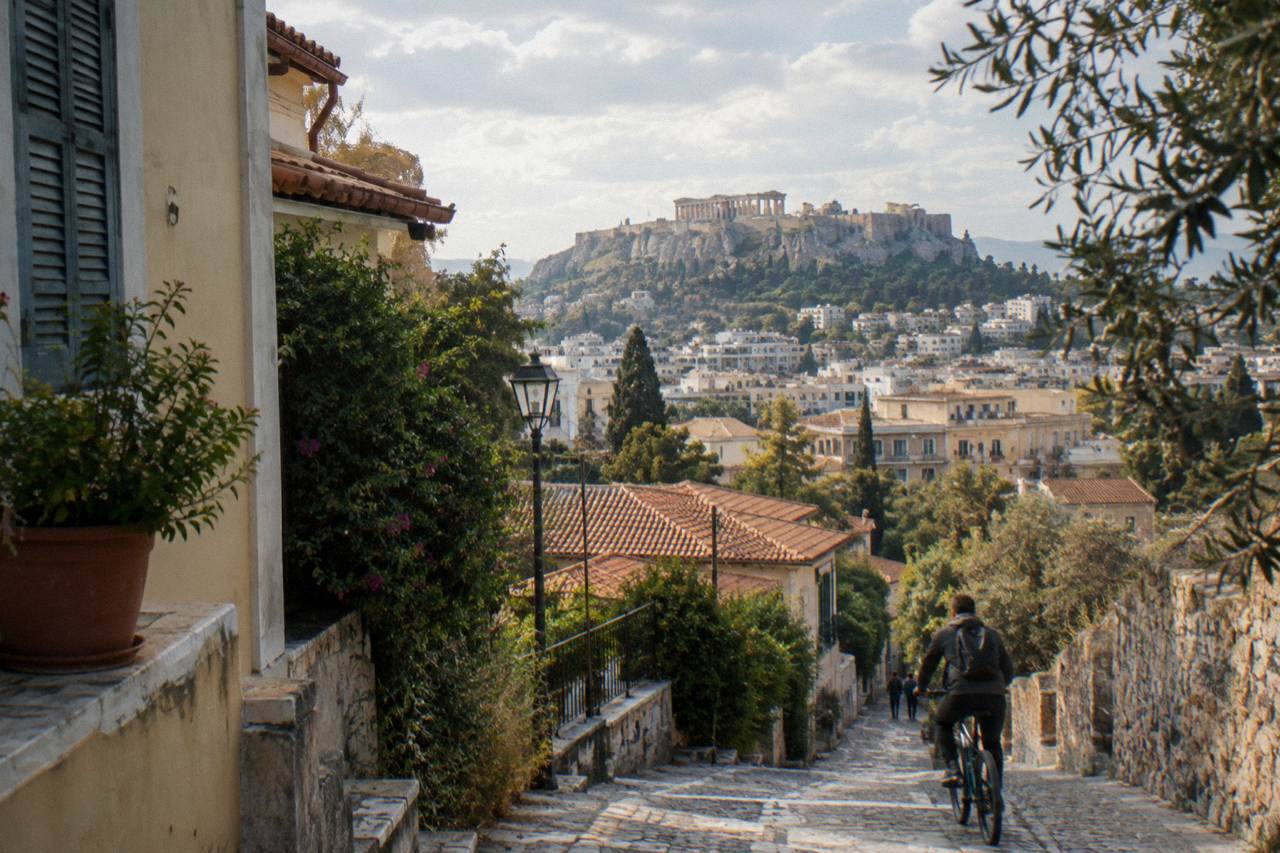
Athens is a city that makes sense fast once you see it from above or from a saddle. The Acropolis sits on its plateau at the centre, Plaka spills down its north slope, and the Ancient Agora, Hadrian's Arch and the Panathenaic Stadium all sit within easy rolling distance of each other. First-time visitors often arrive expecting a museum city and find a dense, lived-in capital instead, with marble underfoot, traffic around it, and a coastline a tram ride or a bike ride away.
This page lays out the things to do in Athens in the order a first-timer actually plans them: which landmarks matter, how many days to give the city, how a guided bike tour fits each sight, what to do after dark, where to swim, when to come, and how the metro and buses treat a bicycle. Prices, durations and review counts for every tour named here come straight from the operator pages, and none of the figures are estimates.
What Are The Must-See Landmarks In Athens?
Six landmarks carry a first visit: the Acropolis, Plaka, the Ancient Agora, Hadrian's Arch, the Panathenaic Stadium and Lycabettus Hill. All but Lycabettus sit on the flat ground around the Acropolis, which is exactly why a bike tour passes so many of them in one loop. Give the Acropolis a full morning on foot, then let wheels carry you past everything else.
The Acropolis is the reason most people book the flight, and it deserves the longest single block of your trip. The site rises above the city on a limestone plateau, with the Parthenon as its centrepiece, and the climb is steep marble that turns slippery when polished by feet. Walk it slowly, early, and with water. Entry arrangements and ticketing are best checked on the official archaeological e-ticket page, since hours and prices are not reproduced here.
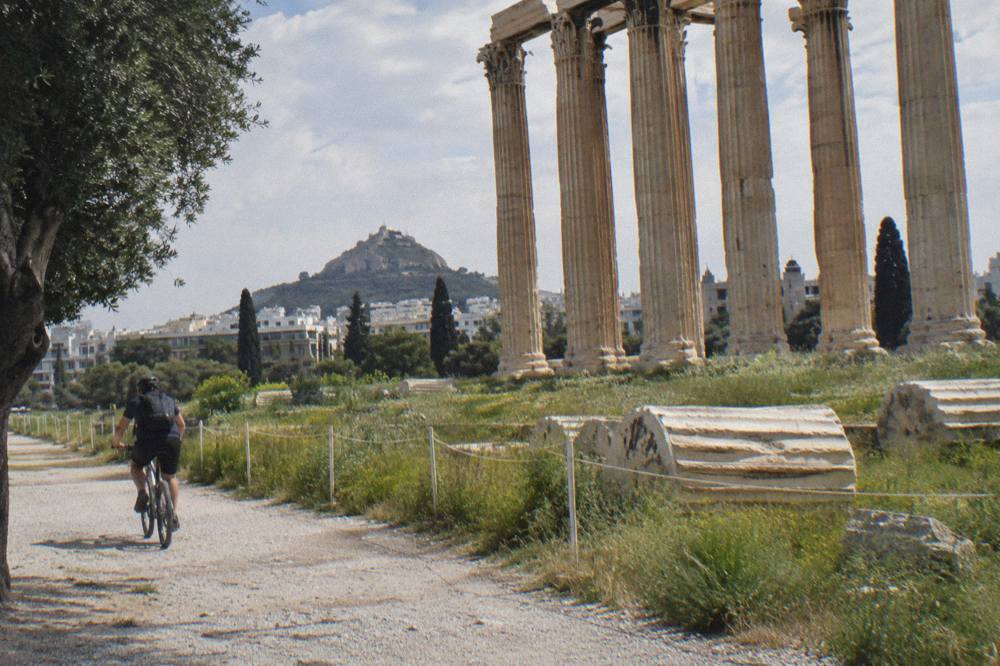
Plaka wraps around the Acropolis's north and east slopes, an old quarter of balconied houses and pedestrian lanes. It needs no ticket and no plan; an hour of wandering is enough. Below it, the Ancient Agora was the civic heart of classical Athens, a wide flat site that rewards a proper visit rather than a glance. Hadrian's Arch and the columns of the Temple of Olympian Zeus stand beside it near the national gardens, and the Panathenaic Stadium, the marble bowl that hosted the first modern Olympic Games, sits just behind.
Lycabettus Hill is the one landmark that asks for real climbing. The summit view sweeps from the Acropolis to the sea, and the funicular or the paths both work; the hill is also the classic place to watch the sun go down over the city. General background on all of these is in the Plaka and Ancient Agora guides elsewhere on this site.
| Landmark | What it is | How a bike tour passes it |
|---|---|---|
| Acropolis | Hilltop citadel and Parthenon | Rides circle the base on the scenic loop; an optional licensed-guide visit is offered on some tours |
| Plaka | Old quarter below the citadel | Ridden through on nearly every historic-centre route |
| Ancient Agora | Classical civic square and ruins | Passed on historic-centre routes, entry not included unless stated |
| Hadrian's Arch | Roman gateway on Amalias | A standard photo stop on central Athens loops |
| Panathenaic Stadium | Marble Olympic stadium | Viewed from outside on most loops of the national gardens area |
| Lycabettus Hill | Highest hill in central Athens | Not part of flat central tours; reach it on foot or by funicular |
How Many Days Do First-Time Visitors Need In Athens?
Three days is the comfortable answer, and two is workable. Day one goes to the Acropolis and Plaka, day two to the Agora, the arch and the stadium on a bike, day three to either the coast or a day trip. A 2 hour 30 minute guided ride compresses the whole central circuit into one morning, which is why planners slot a tour early in the stay.
A three-day structure works because the city is genuinely compact at its core. On the first day, walk: the Acropolis in the morning before the heat, then Plaka and dinner. On the second, take wheels: a guided ride puts the Agora, the arch, the stadium and the changing neighbourhoods into one route with a guide narrating, which is more context than most guidebooks give. The most reviewed ride of the options covered here, the Regular or E-Bike, Optional Acropolis tour, runs 2 hours 30 minutes, is rated 5.0 across 3,666 reviews, and costs from $40.12 per person, with the bike, helmet and tour leader included, per its live booking page.
The third day splits by season. In summer, the coast wins: the Athens Riviera runs south from the city, with Glyfada and Voula both reachable on a guided coastal ride. In the cooler months, the hills or the museums fill the slot instead. If you are weighing a shorter stay, the three days in Athens question is treated in its own piece, and the short answer is that two days cover the core if you use a tour to accelerate day two.
| Day | Focus | Best format |
|---|---|---|
| 1 | Acropolis, Plaka, dinner | On foot, morning start |
| 2 | Agora, arch, stadium, neighbourhoods | Guided bike tour of the historic centre |
| 3 | Coast, or hills and museums | Coastal ride, or walking and the funicular |
Which Athens Bike Tour Fits Each Sight You Want To See?
Match the tour to the sight, not the other way round. The Acropolis itself calls for a tour with entry tickets included, from $79.09 per person over 4 hours 30 minutes. The wider historic centre suits the 2 hour 30 minute scenic ride from $40.12. Evening light belongs to a sunset ride from $33.24. The sea needs a coastal route of 3 hours 30 minutes or more.
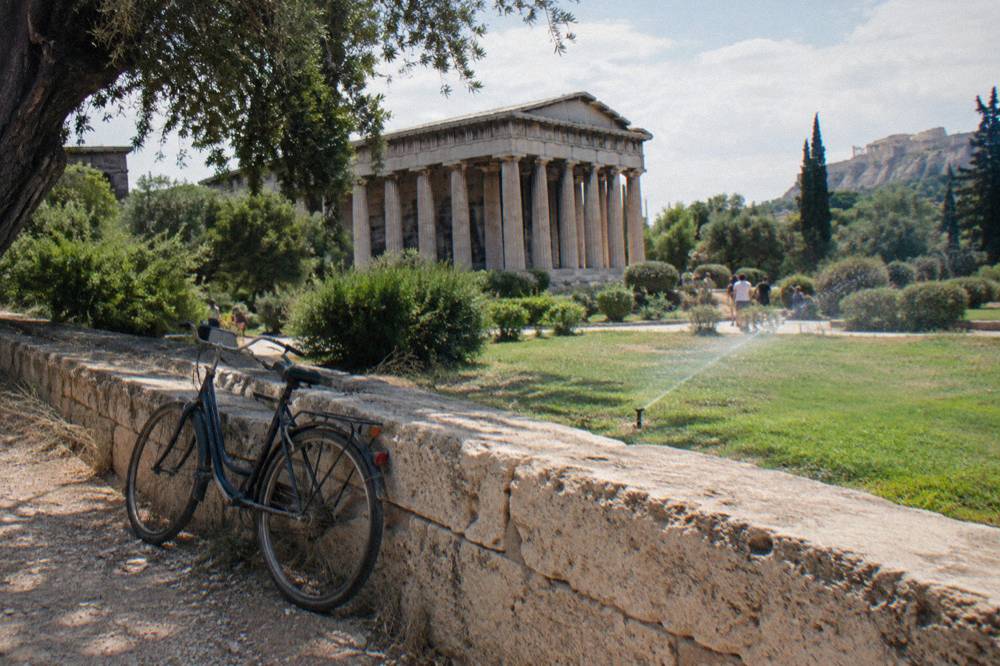
The central circuit is best understood as one family of tours from the same operator, meeting at Athanasiou Diakou 16, just under the Acropolis's south slope. The scenic Regular or E-Bike ride, from $40.12 per person and rated 5.0 across 3,666 reviews, runs 2 hours 30 minutes in groups of no more than 12, with a bike and a tour leader included in the price, and the choice of pedal or electric bike left to the rider, while the listing states whether a helmet is provided. A nearly identical small-group version runs from $33.24 per person and carries a 5.0 rating across 1,264 reviews. For the Acropolis itself, the E-Bike Tour with Tickets Included bundles entry into the price of $79.09 per person over 4 hours 30 minutes, which removes the queue-and-timing problem from your day entirely.
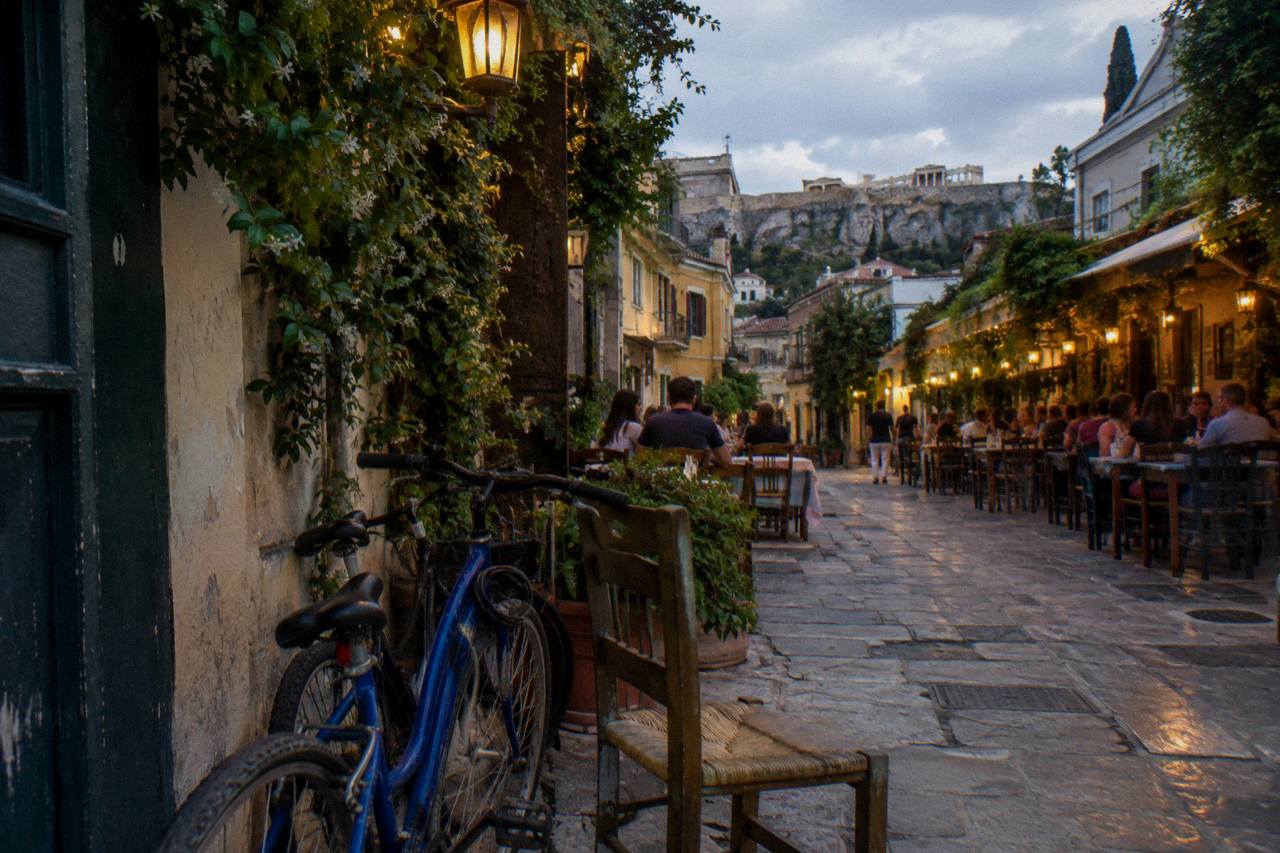
Evening is the third window. The Sunset Ride with Regular or E-Bike, from $33.24 per person and rated 5.0 across 169 reviews, takes the same centre at the hour when the marble goes gold. The lowest from-price among the rides with 15 or more reviews is shared by this sunset tour and the Small Group E-Bike Tour, both at $33.24 per person, which makes the sunset option a natural pick for travellers who want the photographs more than the commentary.
Between the centre and the coast sits a useful hybrid. The City to Sea E-Bike tour, from $51.58 per person over 4 hours 30 minutes and rated 4.9 across 273 reviews, adds a pastry tasting and runs in groups of up to 15 on e-bikes. It is the right pick when one ride has to cover both the ruins and the water.
A planning note on helmets and rules, since riders ask. Under the Greek road code published in the Government Gazette on 13 June 2025, a helmet is recommended but not mandatory for bicycle riders, including e-bikes sold as bicycles; it is mandatory for riders of e-scooter-type light personal electric vehicles, with a 30 EUR fine attached. Nearly all the tours above include a helmet and spell out the bike-and-guide setup, and each live booking page states exactly what is covered. Article 44 of the road code sets out the cyclist rules, and the deeper dive is in the cycling rules in Greece guide.
What Should You Do In Athens After Dark?
Athens after dark is a distinct proposition, and the roster lists three sunset and night rides that lean into it. A 2 hour night highlights ride from $54 per person, rated 4.9 across 580 reviews, passes the lit Acropolis and the squares, while a 3 hour night tour from $51 per person adds a bottle of water and a Greek treat and runs 4.8 across 105 reviews. Both need booking ahead in season.
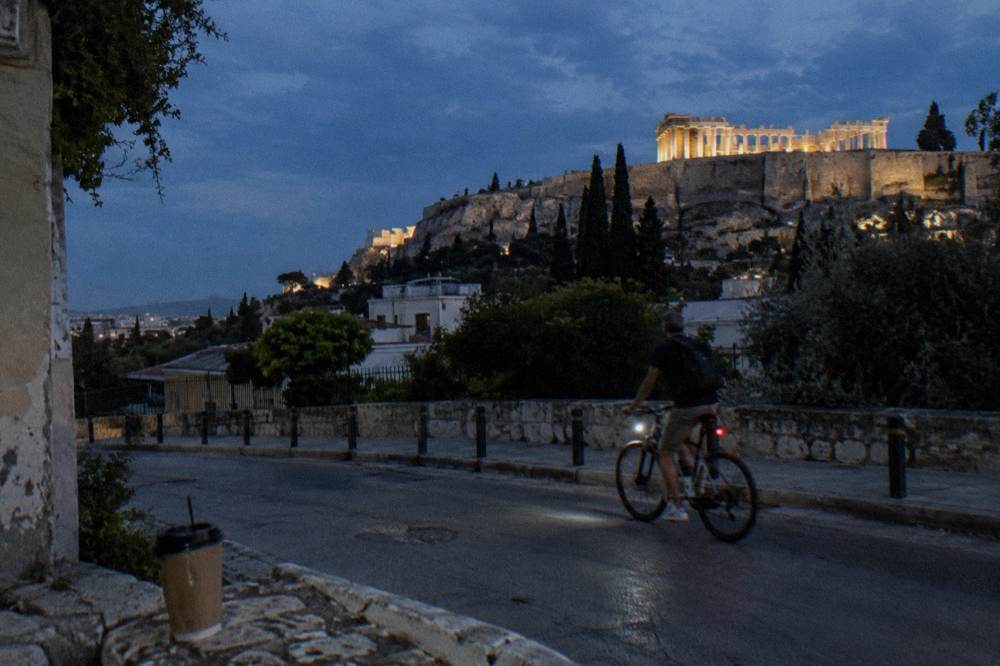
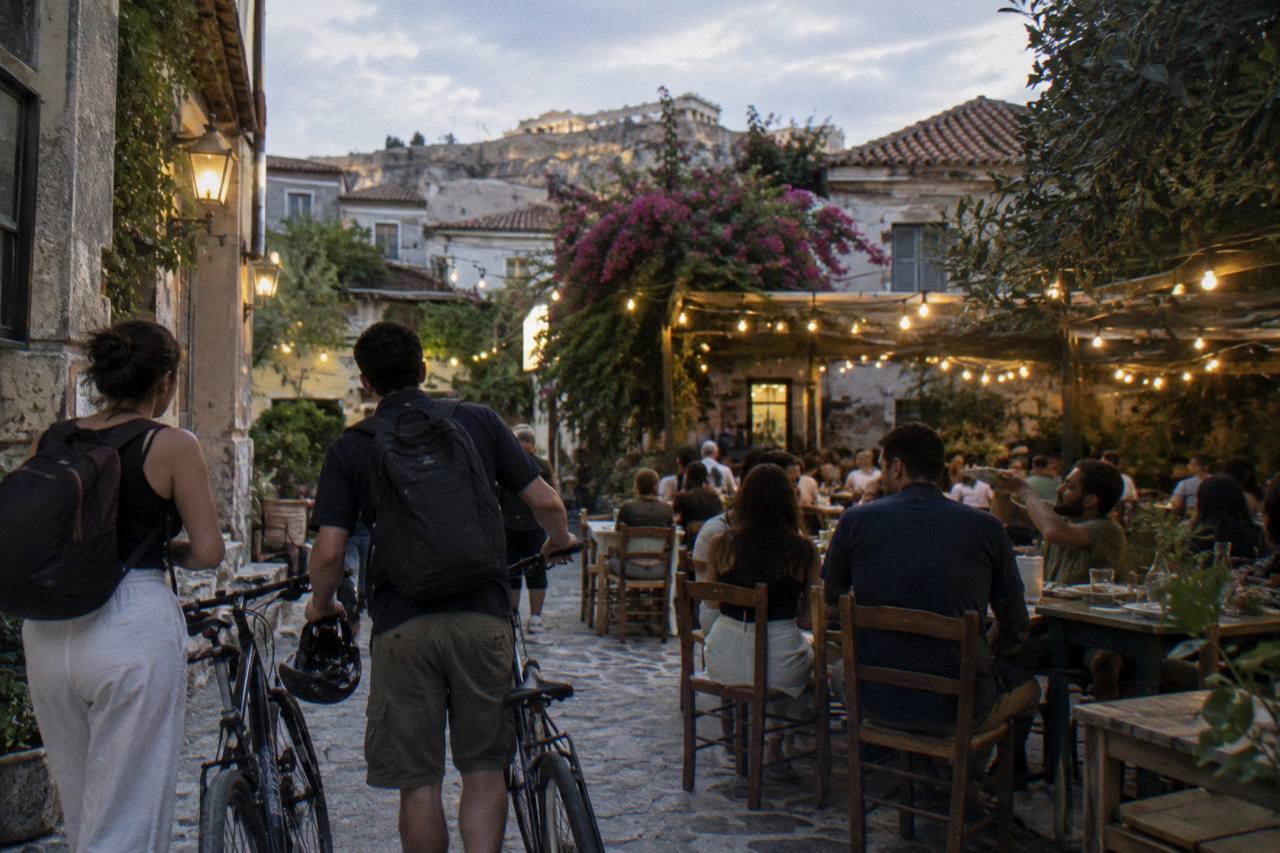
The floodlit Acropolis is the obvious anchor of an Athens evening, and the viewing is free: the slopes and the surrounding streets give the best angles of the lit ruins from below, no ticket needed after closing time. Around it, the bar and taverna economy of Psyrri and Monastiraki runs until late, and Syntagma Square stays a crossroads of street music and strollers. The fuller background is in the Athens at night guide.
Two guided rides serve the same hours. The 2-Hour Night Highlights E-Bike tour from We Bike Athens, from $54 per person and rated 4.9 across 580 reviews, is the shortest way to see the lit centre with a guide and a helmet in the price. The Night Ride from electricityrides, from $51 per person over 3 hours and rated 4.8 across 105 reviews, includes a bottle of water and a Greek treat with the e-bike and guide. For travellers who prefer the daytime version of the same light, the sunset option in the section above is the softer choice.
Is Athens Walkable And Cyclable Between The Sights?
Yes, unusually so. The core sights cluster close together, and a bicycle covers the ground between them far faster than walking ever could. The catch is marble and traffic: surfaces are polished and slippery, some lanes are shared with cars, and the road code expects riders to dismount when pedestrians are endangered.
The practical answer is that walking and cycling divide the city cleanly. Walking wins inside Plaka, on the Acropolis itself, and in the market streets where a bike is a burden. Cycling wins everywhere between: the route from the Acropolis area to the Ancient Agora, around the national gardens to the stadium, and out along the coast to the south is all rideable ground, and the guided tours exist precisely because the routing is not obvious to a newcomer. The cycling routes in Athens guide maps the main circuits in more depth.
Safety concerns are mostly about surface and traffic rather than anything else. The road code bans riding two abreast and riding with headphones, both with fines attached, and the Ministry's published table of road-code fines lists most minor cyclist violations at 30 EUR. Guided tours absorb most of this: the guide picks the lane, the pace is set for a mixed group, and the bike and helmet come with the booking. The honest general picture, including where the marble is worst, is in is cycling in Athens safe.
For a newcomer who has not ridden in city traffic before, a guide removes nearly all the friction. The beginner-friendly tour options are covered separately, and the short version is that e-bikes flatten both the hills and the confidence problem.
What About Food, Markets And Neighbourhood Life?
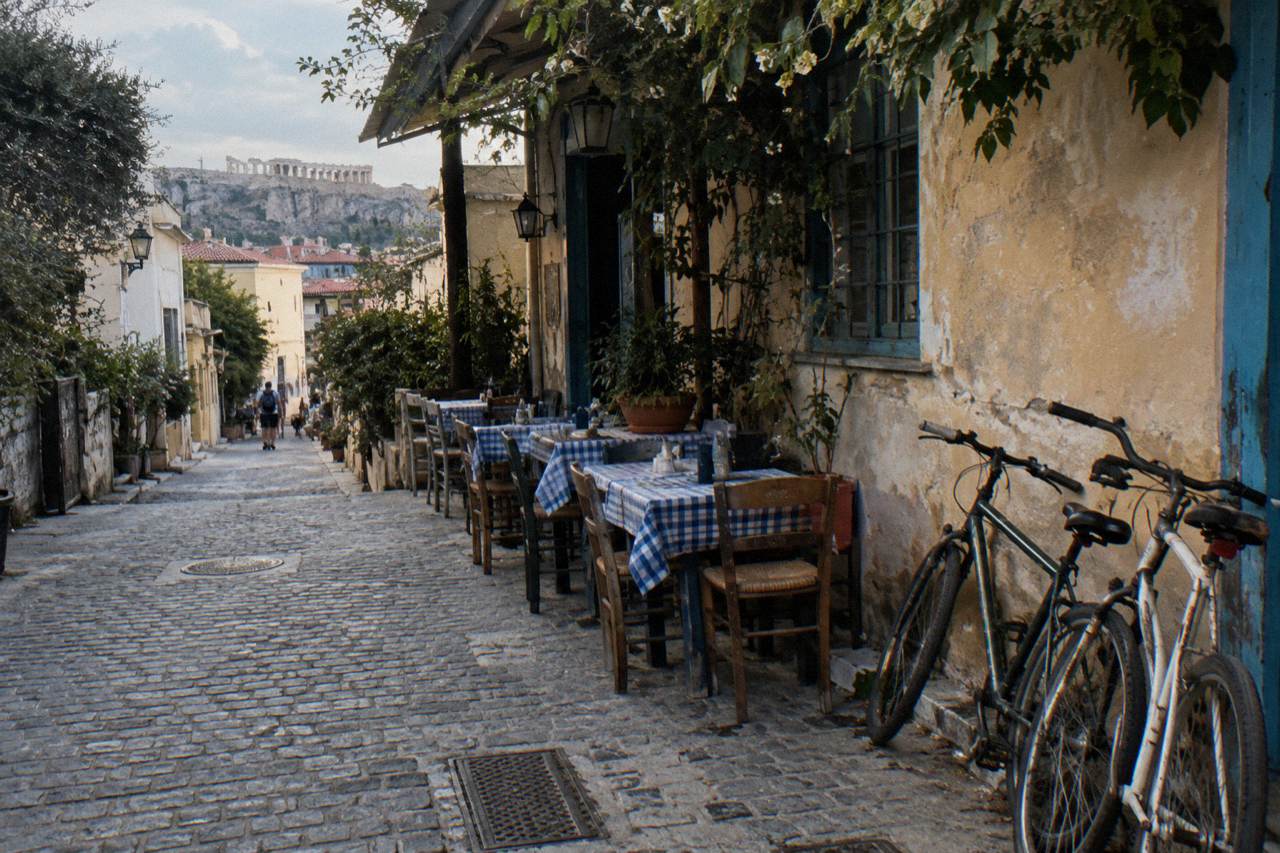
Do not treat meals as a break from sightseeing; in Athens they are the sightseeing. A traditional bakery on a bike route, a mezze lunch in Psyrri, and an evening ouzo stop together tell the city's story as clearly as any ruin. Two tours bundle food directly: a private ride with wine or ouzo from $103.16 per person, and a highlights ride with light refreshments from $45.28.
- Riviera And Coast Rides$28.66
- E-Bike Tours$33.24
- Sunset And Night Rides$33.24
- City And Acropolis Rides$40.12
- Private And Day Trips$61.90
Greek eating runs on small shared plates, and Athens renders that in neighbourhood form: the central market streets, the bakery counters with syrup pastries, the coffee culture that turns a square into a two-hour event. A guided ride that stops for a tasting turns the geography lesson into a lunch. The City to Sea E-Bike tour named above includes a pastry tasting; the private We Bike Athens option, from $103.16 per person over 3 hours 30 minutes with the total depending on group size, includes food and a wine or ouzo stop outright, though with 21 reviews it is a niche pick rather than a proven one.
The mainstream alternative is the 3-Hour Ride from Let's meet in Athens, from $45.28 per person and rated 4.9 across 906 reviews, a regular pedal-bike outing with light refreshments; the booking page states the exact bike, helmet and guide inclusions for this tour. For travellers who want food as the headline rather than a stop, the Athens bike and food tour guide lays out the options.
Where Do You Go For Beaches And The Riviera?
The Athens Riviera starts at the city's southern edge and strings together swimming coves, marinas and resort towns. Glyfada and Voula are the classic stops, reachable on a 2 hour coastal ride from $28.66 per person, while a 3 hour 30 minute swimming adventure from $56.16 per person, rated 4.9 across 49 reviews, builds an actual swim stop into the day.
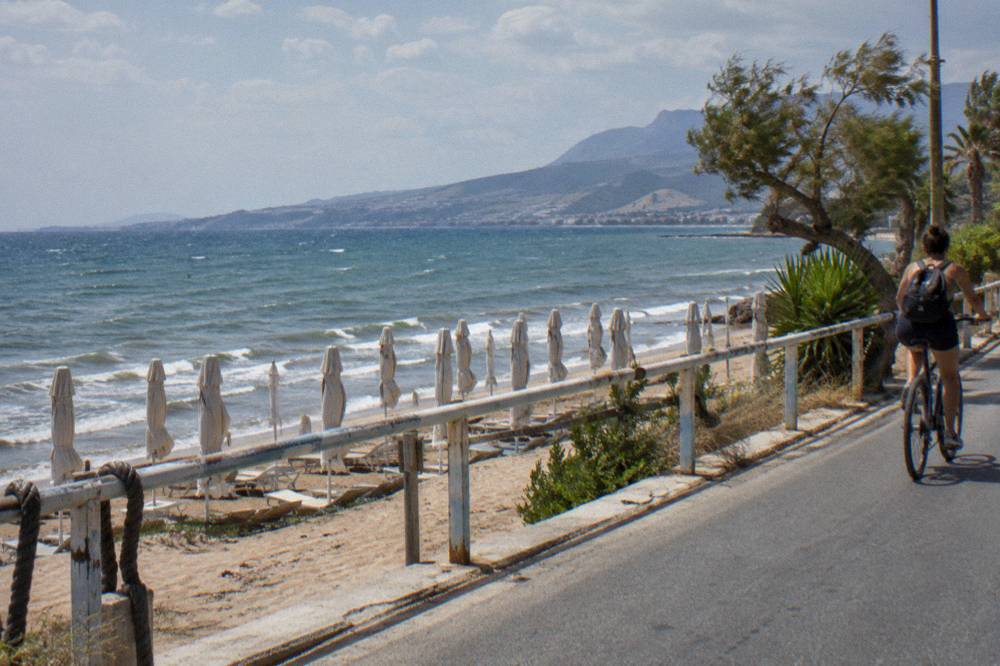
The Riviera is the side of Athens that surprises first-timers: the same metro-area that holds the Parthenon also holds swimmable water within a short ride of the centre. Glyfada is the polished end, with a shopping street and a beachfront; Voula is quieter and more local. Both anchor the coastal tours, and the fuller geography is in the Athens beaches guide and the Riviera guide.
Two rides serve the coastline with room for swimming. The Glyfada to Voula Coast Ride from Melima Experiences starts in Glyfada at Vergoti Square, runs 2 hours in a group capped at 6, and costs from $28.66 per person with bottled water included; it is a new listing with 6 reviews, so treat it as unproven rather than a sure thing. The Coastal Ride and Swimming Adventure from Suncycling Athens, from $56.16 per person over 3 hours 30 minutes and rated 4.9 across 49 reviews, starts in central Athens and adds the swim stop to the route.
| Coastal tour | Duration | From price | Group cap | Swim stop |
|---|---|---|---|---|
| Glyfada to Voula Coast Ride | 2 hours | $28.66 | 6 | No, beach time on your own |
| Coastal Ride and Swimming Adventure | 3 hours 30 minutes | $56.16 | 10 | Yes, built into the route |
| City to Sea E-Bike (central) | 4 hours 30 minutes | $51.58 | 15 | Coastal stretch, pastry tasting |
When Is The Best Time To Visit Athens For This Plan?
April, May, late September and October are the sweet spots: warm days, long light and thin crowds. July and August average 28.3 and 28.2 C with maxima near 32.2 C at the coast and higher in the centre, which pushes riding to mornings and evenings. November is the wettest month of the first half of the cold season, with 60.1 mm over 10.9 days, and December 62.0 mm over 13.5 days.
The climate figures above are HNMS climate normals for the Elliniko coastal station, and central Athens runs warmer by day than that station reads. What that means for a first visit is simple: in high summer, the guided rides are best booked for the first morning slot or the sunset slot, and the Acropolis walk should start at opening time. Heat practice matters here too; the Ministry of Culture closed the Acropolis from 1 p.m. to 5 p.m. on 8 and 9 July 2025 when temperatures approached 40 C, a single verified case, but one that shows afternoon closures genuinely happen in heat waves. The month-by-month detail, including what to wear, is in the Athens weather by month guide and the summer heat guide.
One date worth flagging ahead of time: the 43rd Athens Authentic Marathon runs on 7 and 8 November 2026, with vehicle closures including bicycles on Irodou Attikou and Vas. Georgiou B from Thursday 5 to Monday 9 November, and on Vas. Konstantinou, Arditou and Vas. Sofias during their own weekend windows. Public transport changes run 6 to 8 November. If your trip lands on that weekend, expect central rides to be affected and book around the race days; the official details are on the marathon site.
| Season | Conditions at Elliniko | What it means for the plan |
|---|---|---|
| April to May | Means 16.1 to 20.9 C, 9.3 down to 6.4 rain days | Best all-round riding and walking |
| June to August | Means 25.6 to 28.3 C, maxima near 32.2 C | Book morning or sunset tours, walk the Acropolis early |
| September to October | Means 24.3 then 19.6 C, rain days rising 4.7 to 8.6 | Second sweet spot, sea still warm |
| November to March | Means 10.3 to 15.4 C, 10.9 to 13.5 rain days in the wettest months | Fewer crowds, pack a rain layer |
How Do You Get Around Athens Without A Tour?
The metro is the backbone, and it takes bikes: up to two bicycles ride in the last door of each train, carried on the elevators, never the escalators. Buses accept only folding bicycles in a holder. A 90-minute ticket costs 1.20 EUR, a day ticket 4.10 EUR, and a 3-day tourist ticket 20.00 EUR covering the Airport link. Taxis and the tram network fill the gaps.
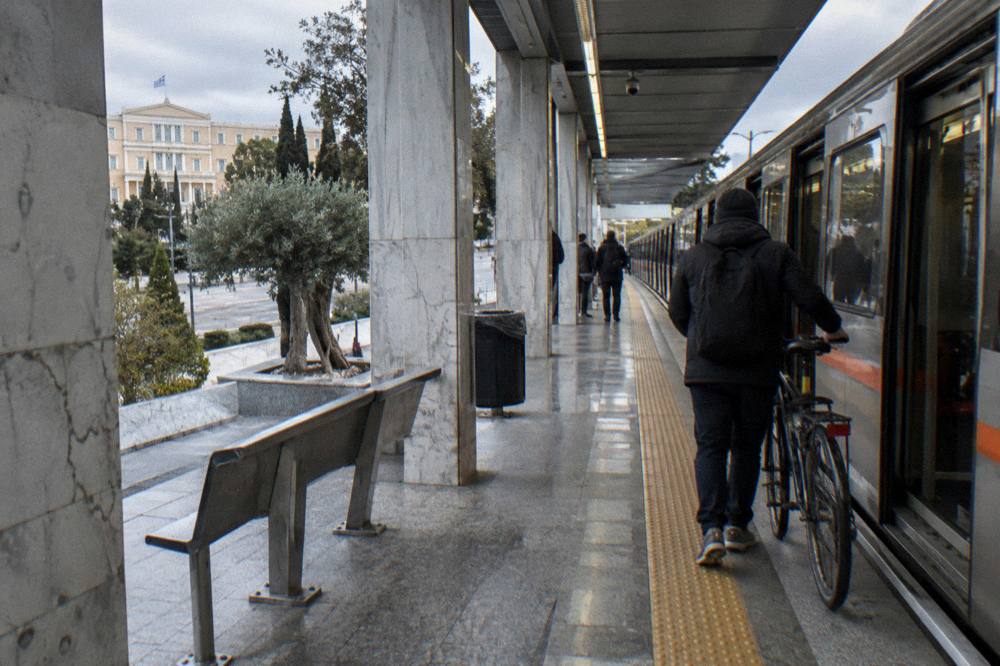
For a first-timer, the metro connects the airport to the centre and the centre to the coast-bound transfer points, and the Athens metro guide covers the lines and the ticket mechanics in full. The bicycle rules come from the OASA passenger regulation: two bikes maximum in the last door of each metro train, carried by the rider, using elevators rather than escalators, while buses and trolleybuses take only folding bicycles in the designated holder of at most 33 x 66 x 80 cm. Fares are on the OASA ticket price page.
Longer journeys by rail are also bike-friendly in a limited way. Hellenic Train carries up to four conventional bicycles free on the Athens to Chalkida, Piraeus to Airport and Piraeus to Kiato services, with the carriage limits published on the Hellenic Train bicycle page. That matters for the one day trip in the tour set: the Aegina E-Bike and Walking day tour, from $158.18 per person over 12 hours as a private trip with the total depending on group size, handles the island logistics itself, so a traveller booking it does not need to work out any of this.
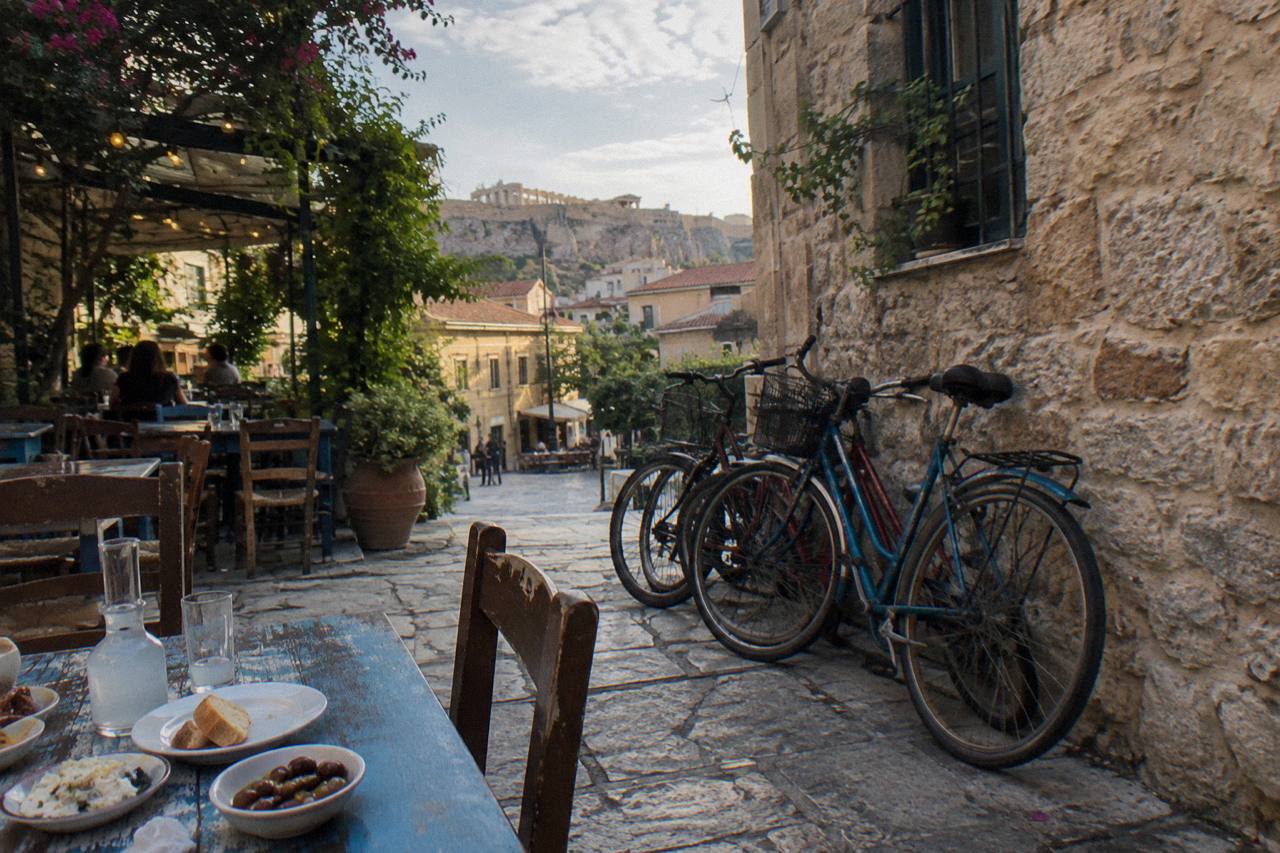
One thing not to assume: a municipal bike-share network. The Municipality of Athens announced a public auction in September 2026 to lease a network of at least 200 e-bikes across 50 stations with 340 docking positions, but no dock-based scheme is documented as operating yet, so renting from a shop or riding a tour bike remains the way to get wheels. The bike rental guide covers the shop route.
| Ticket | Price | Notes |
|---|---|---|
| 90-minute ticket | 1.20 EUR | Discounted 0.50 EUR; excludes some services |
| Day ticket | 4.10 EUR | Valid 24 hours including the X80 airport coach |
| 5-day ticket | 8.20 EUR | Multiple rides across five days |
| 3-day tourist ticket | 20.00 EUR | Includes the airport link |
How Do You Book The Tour Into Your Itinerary?
Book the bike tour for day two, not day one. Ride before you queue: a guided loop on the second morning gives you the map, the geography and the guide's context first, and the Acropolis walk afterwards means more. Every tour named here allows free cancellation per the booking page, so a slot held early costs nothing to move.
The booking mechanics are simple enough that they reward doing them early in high season. Small groups fill first: the rides capped at 6, 9 or 10 people go quickest, while the 12 to 20 rider groups hold availability longer. Meeting points cluster around the Acropolis: Athanasiou Diakou 16 sits in Makrygianni near the Acropolis metro, Apostolou Pavlou 53 on the Thiseio side near the Ancient Agora, and Dragatsaniou 6 in the commercial centre by Syntagma. None of the tours offers hotel pickup. Arrive ten minutes early for the bike fitting, and check the what to bring guide for the water, sunscreen and shoe details.
For the tour itself, the choice comes down to format. The Regular or E-Bike, Optional Acropolis ride from $40.12 per person is the most reviewed option at 3,666 reviews and works as the default day-two anchor; the Acropolis tickets-included version from $79.09 removes the site's queueing from your day; the sunset version from $33.24 is the photographer's slot. The trade-offs between pedal and electric are laid out in the e-bike versus regular bike comparison, and the booking-timing question in general is in booking in advance.
Common Questions About Things To Do In Athens
What Are The Things To Do In Athens For First-Time Visitors?
The core list is the Acropolis, Plaka, the Ancient Agora, Hadrian's Arch, the Panathenaic Stadium, an evening under the lit Acropolis, and a half day on the Riviera if the season allows. A guided 2 hour 30 minute bike tour from $40.12 per person stitches the central sights into one loop, which is why it anchors most first itineraries.
Can You See Athens By Bicycle As A First-Timer?
Yes, and it is one of the faster formats. The historic centre is compact, and nearly all listed tours run in guided groups of 6 to 20 with bike, helmet and guide included, as each booking page details. Regular and electric bikes are options on several rides, so fitness is not the barrier it looks like.
How Many Days Do You Need For A First Visit?
Three days is comfortable and two is workable. Day one for the Acropolis and Plaka on foot, day two for the wider centre on a guided ride, day three for the coast or the museums.
Are Helmets Mandatory On A Bike In Greece?
No. Under the Greek road code published in the Government Gazette on 13 June 2025, helmets are recommended but not mandatory for bicycle riders, including e-bikes. They are mandatory for e-scooter-type light personal electric vehicles, with a 30 EUR fine. Nearly all listed tours include a helmet with the bike; the booking page confirms what each covers. The E-Bike Tour, Acropolis Tickets Included, from $79.09 per person over 4 hours 30 minutes, rated 5.0 across 741 reviews. The scenic ride from $40.12 offers an optional licensed-guide Acropolis visit with the ticket only when that option is selected. It is hot but manageable with the right slot. July and August average 28.3 and 28.2 C at the coastal Elliniko station with maxima near 32.2 C, and the centre runs warmer. Book a morning or sunset ride, as heat practice in Athens shows: the Acropolis closed for afternoon hours on two July days in 2025 near 40 C.Which Athens Tour Includes Acropolis Entry Tickets?
Is August Too Hot For A Bike Tour In Athens?
The pattern that holds all of this together is simple. Athens gives a first-timer a tight cluster of world-class sights, a working city around them, and a sea at the edge. A bike tour does not replace the slow parts, the Acropolis walk and the long dinners, it makes the rest of the map legible in a single morning, and the Bike Tours Athens comparison pages exist to help you pick which morning that is.