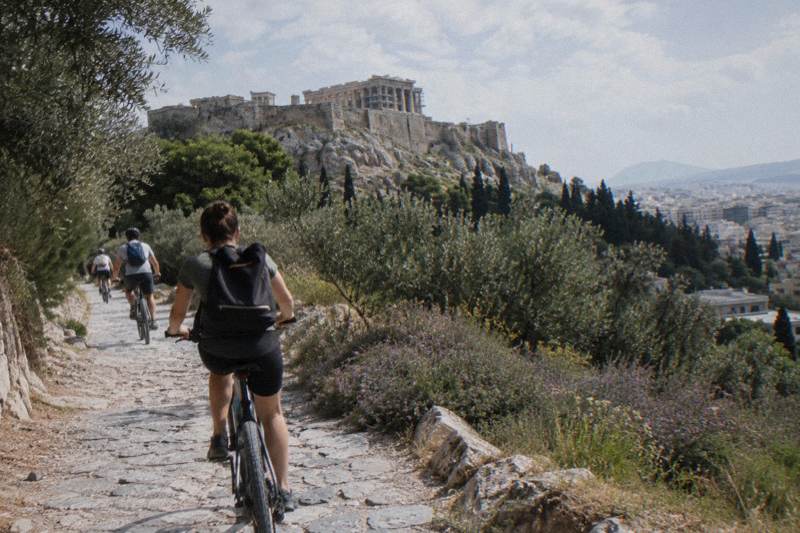
What To Bring On An Athens Bike Tour
The bike, the helmet and the guide are already covered by the booking. Everything else, from water to identification, is on the rider.
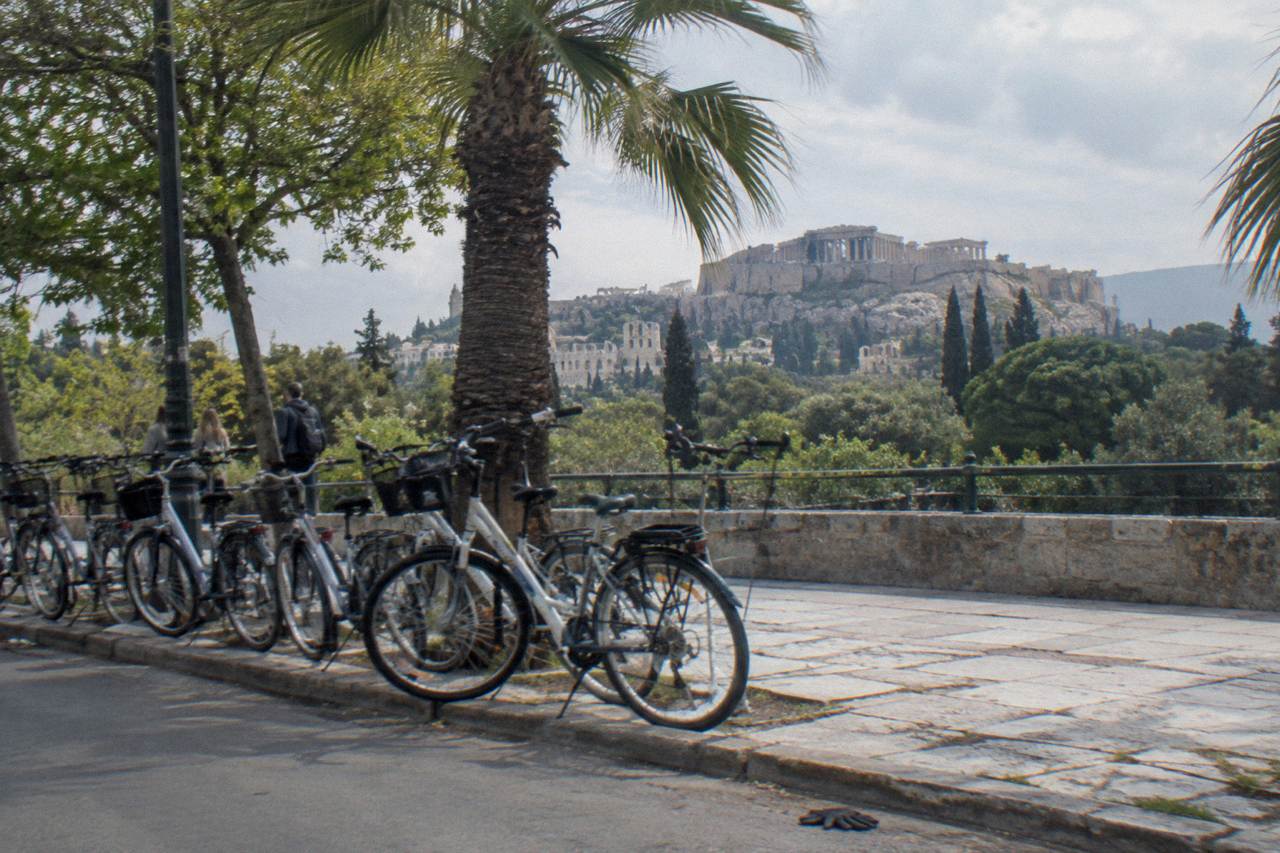
Short answer
Bring a passport or ID for the booking, a refillable water bottle, sun protection, comfortable closed shoes and a small bag that straps to the body. The tours covered here supply the bicycle, the helmet where stated and the guide, so the packing question is mostly about heat, marble surfaces and the small items a rider cannot afford to leave at the hotel.
A guided bike tour in Athens is one of the few city activities where the operator carries most of the weight. The bicycle arrives at the meeting point, the helmet comes with it where the listing says so, and a local guide handles the route, the traffic judgments and the history. That leaves a short, specific list of things the rider still has to bring, and most of that list exists because of two local realities: summer heat that pushes the Acropolis itself into afternoon closures, and polished marble pavements that reward sensible shoes. This guide works through the list item by item, separates what a booking already covers from what it does not, and flags the Greek road code rules that decide what stays behind.
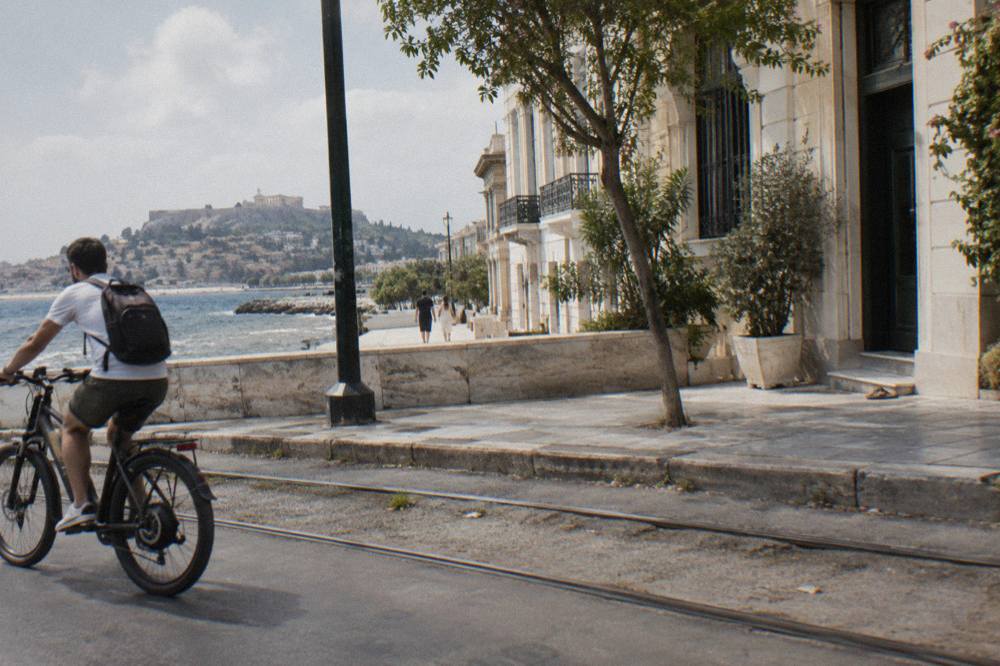
What Should You Actually Pack For An Athens Bike Tour?
The core list is short: identification for the booking, a refillable water bottle, sunglasses and sunscreen, a hat that fits under a helmet or a bandana, closed flat shoes, a light layer for evening rides, and a small crossbody bag or a secure pocket for valuables. Everything else is optional weight on a hot climb. None of this needs specialist gear. A rider who owns a pair of trainers and a refillable bottle is already equipped for every standard city tour on this site.
Water comes first. The HNMS climate normals for the Elliniko coastal station put July and August means at 28.3 and 28.2 degrees Celsius, with maxima near 32.2 C, and central Athens runs warmer by day than that coastal reading suggests. A body on a bike, on sunlit asphalt, needs more water than most people instinctively carry. Riders who prefer not to carry a bottle at all can pick tours where bottled water is already part of the package: the Historic E-Bike, 1.5 to 2.5 Hours ride lists bottled water included, as do several others.

Sun protection is second, and it matters more than clothing choice. Most Athens routes put riders on open streets for the whole duration, and the two-and-a-half to three-hour formats that dominate the city mean sun exposure is continuous. Sunglasses do double duty against glare and against the dust that traffic throws up on dry summer roads.
Identification is third, and riders forget it constantly. Meeting a guide for a booked tour usually means giving a name, and a passport or ID card resolves any mismatch instantly. It also matters on the road: Greek rules require riders to be able to identify themselves, and it is the one item that cannot be replaced by a phone screenshot if a booking confirmation email goes missing. The Athens bike tour cost guide covers the money side of the same trip.
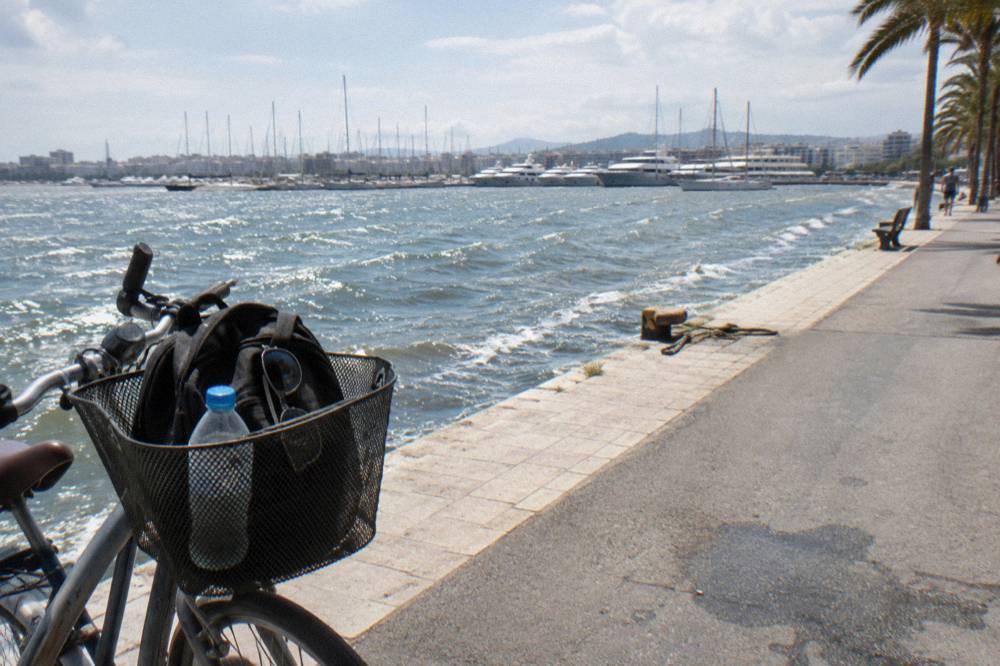
Here is the core list in one place, with the reason each item earns its spot.
| Item | Why it earns a place | Athens-specific note |
|---|---|---|
| Passport or ID | Booking check and legal identification | Keep it in a zippered pocket, not a loose jacket |
| Refillable water bottle | Heat, duration, continuous sun exposure | Bring even on tours that include bottled water |
| Sunglasses | Glare and road dust | More useful than a wide-brim hat on a bike |
| Sunscreen | Two to three hours of open riding | Apply before the ride, carry nothing bulky |
| Closed flat shoes | Pedalling and slick marble at photo stops | Skip flip-flops for any route with stops |
| Small crossbody or hip bag | Phone, keys, documents while riding | Avoid handbags, nothing on handlebars |
| Light layer | Morning, evening and night rides | Useful on sunset tours from spring to autumn |
One item that does not belong here: a phone mount. There is no need to navigate, because that is the guide's job, and hand-held phone use while riding is banned outright under Greek law, as the road rules section below explains.
What Does The Tour Booking Already Cover?
On the standard Athens city rides, the booking supplies the bicycle, a helmet where the listing states one, and a licensed local guide, plus a drink or snack on some formats; hotel pickup is almost never part of the price, and Acropolis entry is included only where the listing says so. A rider who reads the inclusions line closely can cut their own packing list almost in half, because the heavy and bulky items are the operator's problem, not the rider's.
The pattern is consistent across the operators working in the city centre. The Regular or E-Bike, Optional Acropolis tour from Athens by bike, a 2 hour 30 minute ride rated 5.0 across 3,666 reviews, includes the bike, the helmet and the guide, and lets each rider choose a regular bicycle or an e-bike. The same applies to the Highlights Of Athens Biketour from Let's meet in Athens, a 3 hour ride rated 4.9 across 906 reviews, which adds light refreshments to the package. Riders comparing formats can cross-check with the Athens e-bike tour guide.
The exclusions are just as consistent, and they are where packing actually starts. Hotel pickup and drop-off appears on the not-included list of nearly every Athens tour, which means getting to the meeting point is the rider's own logistics: all 31 tours covered on this site start in Athens, at meeting points in the Acropolis area, Koukaki, Thiseio, the commercial centre near Syntagma and Glyfada. The where Athens bike tours start guide maps those meeting points in detail.
Two exclusions deserve special attention. The Regular or E-Bike, Optional Acropolis tour lists its licensed-guide Acropolis visit as optional, with the Acropolis entry ticket not in the from-price unless that option is selected, so a rider planning to enter the site should confirm the option at booking. Riders who would rather not think about tickets at all can book the E-Bike Tour, Acropolis Tickets Included, which bundles entry into its from $79.09 per person price. For anything the listing does not spell out, the official archaeological sites e-ticket page is the place to check hours and prices directly, since this guide does not reproduce them.
This table shows how the common inclusions fall across a representative set of tours from the booking pages.
| Tour | Duration | Bike | Helmet | Guide | Food or drink |
|---|---|---|---|---|---|
| Regular or E-Bike, Optional Acropolis | 2 hours 30 minutes | Included | Included | Included | Not listed |
| Highlights Of Athens Biketour | 3 hours | Included | Included | Included | Light refreshments |
| Neighborhood Ride, Helmet Included | 2 hours 30 minutes | Included | Included | Not stated | Not listed |
| Small Group, Optional Acropolis Stop | 2 hours 30 minutes | Included | Included | Included | Not listed |
| Sunset Ride, Regular or E-Bike | 2 hours 30 minutes | Included | Included | Included | Not listed |
A rider carrying this table in their head on packing morning needs only their own small items. The machine, the head protection and the local knowledge arrive with the guide.
What Should You Wear On An Athens Bike Tour?
Wear closed, flat shoes with grip, light breathable layers for daytime rides or a light jacket for sunset and night tours, and avoid anything loose that can catch in a wheel or chain; shorts and a t-shirt are the summer standard, and long loose skirts or flapping scarves are the main things to leave behind. Marble at the photo stops is the deciding factor for footwear: much of central Athens pavement is polished stone that turns slick when wet or dusty, and slides are the most common way a rider hurts themselves on these routes.
The shoes matter more than people expect. Athens routes thread through pedestrianised streets around the Acropolis and Plaka, and riders dismount repeatedly for photos and commentary. Trainers handle both the pedalling and the walking. Sandals with straps work for some, but anything with a smooth sole is a poor choice after a rain shower or on dust-coated marble, and flip-flops are a genuine hazard on a bike.
Clothing follows the season. From late May through September, the climate table makes the case on its own: July and August mean temperatures around 28 degrees Celsius with maxima near 32.2 C, under two rain days a month, and almost no cloud cover. Light colours, loose but fitted clothing and no heavy cotton. On a sunset ride the same rider wants a light layer, because the temperature drop after dark is real even in midsummer. The what to wear guide goes deeper on seasonal outfits.
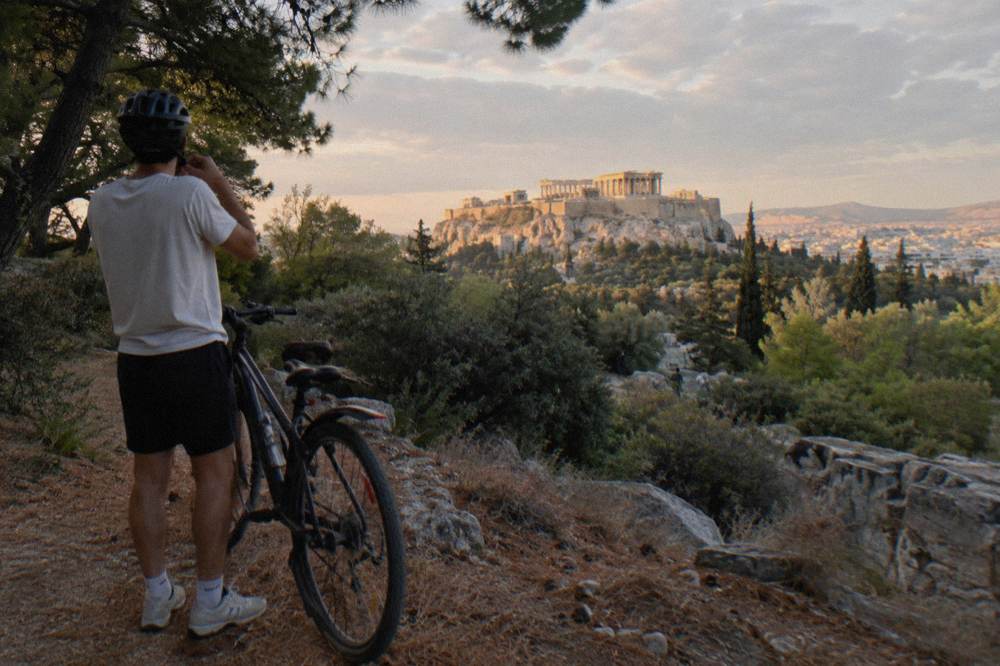
Hair and head follow a simple rule: whatever fits under a helmet. Wide sun hats do not, and a helmet is standard issue on these tours, with the listings showing helmet included on almost every city ride. A cap worn backwards or a bandana solves the sun-strip on the forehead and still lets the helmet sit properly. Under Greek law a helmet is recommended, not mandatory, for bicycle riders, as Article 44 of the road code states. Most listed tours provide one and expect riders to keep it on throughout, though a few listings leave helmets unstated, so check the booking page for each tour before you go.
The packing weight is small enough that clothing choice is really a comfort decision rather than a luggage one. The full seasonal picture, month by month with the temperature and rain-day numbers a planner needs, sits in the Athens weather by month guide.
How Much Water And Sun Protection Do You Need In Athens Heat?
For a daytime summer ride, bring more water than seems reasonable, apply sunscreen before departure, and keep sunglasses on for the full duration; November and December rides need the bottle less but a rain-proof outer layer more, since those are the wettest months on the climate table. The city sits in a hot-summer Mediterranean climate, and the difference between a July ride and a February one is not subtle.
The climate record for the Elliniko coastal station makes the seasonal split explicit. July and August average 28.3 and 28.2 degrees Celsius with fewer than two rain days each. November is the wettest month of the cold half with 60.1 mm of rain over 10.9 days, and December follows with 62.0 mm over 13.5 days. A rider packing in June and a rider packing in December bring almost entirely different bags. The rest of the planning pages sit on Bike Tours Athens.
| Season | Temperature picture | Water plan | Extra items |
|---|---|---|---|
| June to August | Means 25.6 to 28.3 C, maxima near 32.2 C | Carry water, refill at stops | Electrolyte sachets, cap under helmet |
| September to October | Means 19.6 to 24.3 C | One bottle for the ride | Light layer for the last hour |
| November to February | Means 10.3 to 15.4 C, 11 to 14 rain days | Small bottle | Rain jacket, warmer gloves |
| March to May | Means 12.4 to 20.9 C | One bottle | Windproof layer for evenings |
Afternoon heat is not an abstract concern in this city. The Ministry of Culture closed the Acropolis from 1 p.m. to 5 p.m. on 8 and 9 July 2025 when temperatures approached 40 Celsius, one documented instance of the site shutting during the hottest hours. The roster reflects that reality: sunset and night formats exist precisely because midday Athens in high summer is a poor time to pedal, with heat often exceeding 35°C in July and August. The cycling Athens in summer heat guide covers the timing decisions in full.
Sunscreen earns its place even outside summer. The sun in Athens is strong from April onward, and a rider is exposed for the full tour duration with no shade on most streets. A small tube beats a large one, and applying it at the hotel before the ride beats carrying it at all.
What Documents And Booking Items Should You Bring?
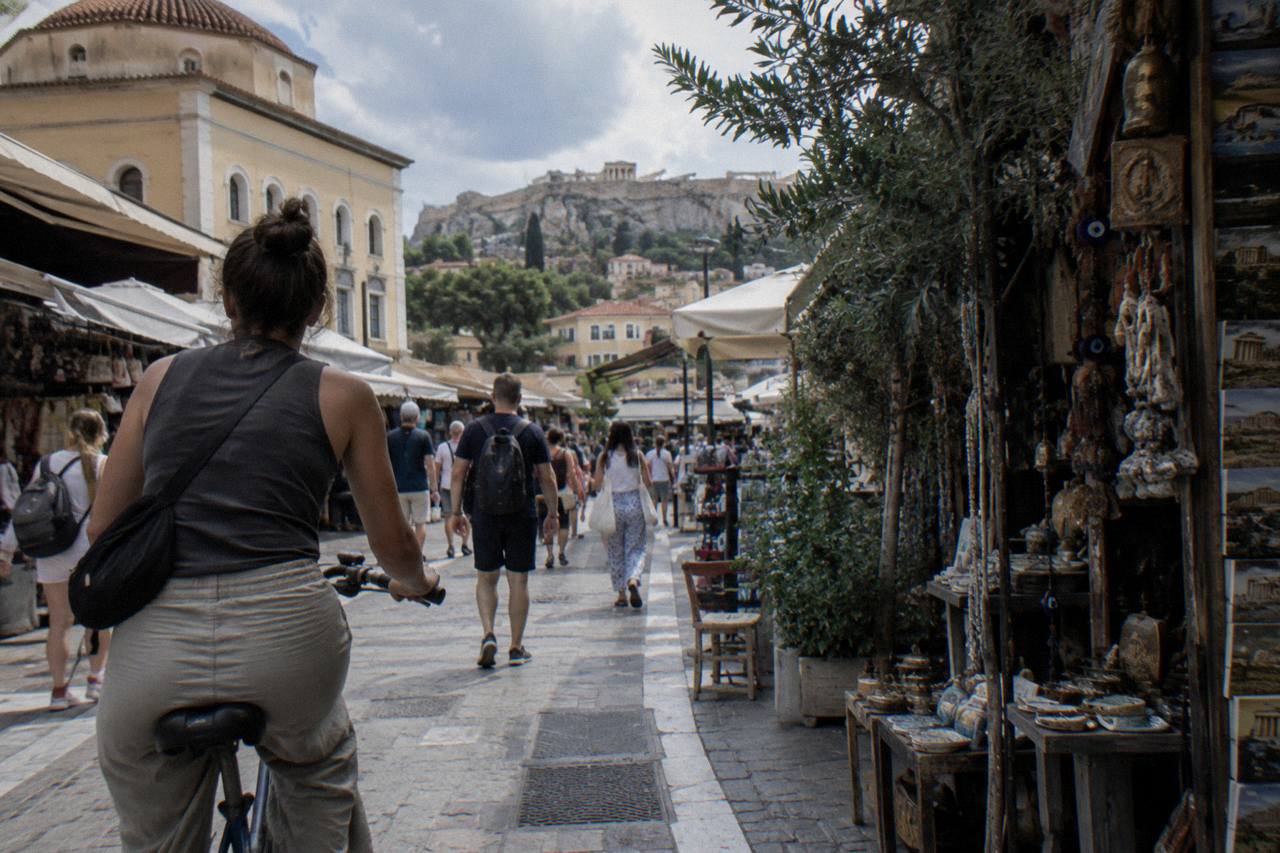
Bring the passport or ID card used at booking, the confirmation email or number accessible offline on the phone, and payment cards in a secure pocket; carry nothing so valuable that losing it would ruin the day, because the rides park bicycles in busy public squares where bags stay on the bike or in a basket. Meeting points in Koukaki, Makrygianni and Thiseio are lively areas close to the Acropolis, and a crossbody bag worn on the body is safer than a tote hooked over handlebars.
The confirmation email deserves a specific word. Phone batteries die at the worst moments, and a printed or screenshotted confirmation with the tour name and the meeting point address saves an awkward ten minutes at the start. Every tour on this site lists its exact meeting point, for example Athanasiou Diakou 16 for the Athens by bike tours and Apostolou Pavlou 53 for the We Bike Athens ones, so the address is always available to check offline before departure.
- Riviera And Coast Rides$28.66
- E-Bike Tours$33.24
- Sunset And Night Rides$33.24
- City And Acropolis Rides$40.12
- Private And Day Trips$61.90
Payment is worth thinking about too. Tours display their prices per person and, on the private formats, the total depends on group size, so the final amount at booking time is the number to plan around. The Historic E-Bike, 1.5 to 2.5 Hours tour from We Bike Athens, rated 4.9 across 1,474 reviews and from $50 per person, is one of the most frequently booked small-group formats in the city, and a card rather than cash covers most operator checkout pages. Booking in advance has its own logic, covered in the book an Athens bike tour in advance guide.
Two small items round out the documents pocket. A card with emergency contact details costs nothing and reads itself when a phone cannot. And for riders on medication, the day-bag version rather than the hotel-bathroom version is the one to bring, because a three-hour ride in heat is exactly when an inhaler or a glucose tablet matters most.
Which Greek Road Rules Affect What You Carry?
The road code bans riding with headphones connected to audio devices and bans holding a phone or smartwatch while riding, so the packing implication is concrete: leave the earbuds in the bag, keep the phone in a pocket or a handlebar bag that closes, and know that both hands belong on the handlebar except when signalling. These are not advisory niceties. The Ministry's published fine table sets 350 EUR for the phone or headphone violations and 30 EUR for riding two abreast or without both hands on the bars.
The law is explicit and recent. Article 80 of Law 5209/2025 sets the lighting and reflector rules for bicycles ridden at night, which is why the night-format tours supply properly equipped bikes and why a private rider renting separately should check the lights. Riders on guided tours are largely insulated from these obligations because the operator supplies compliant equipment, but the personal-device rules apply to every rider on every tour, because they govern what the rider does with their own hands and ears.
| Rule from the road code | Fine | Packing consequence |
|---|---|---|
| No hand-held phone or smartwatch while riding | 350 EUR | Phone stays in a closed pocket or bag |
| No headphones connected to audio devices | 350 EUR | Earbuds stay in the bag for the ride |
| Both hands on the handlebar except to signal | 30 EUR | Nothing carried in the hands, ever |
| No riding two or more abreast | 30 EUR | Single file, even in a chatty group |
| Children under 12 accompanied by a person over 16 | 30 EUR | Family riders: the ride is on the list, see the kids guide |
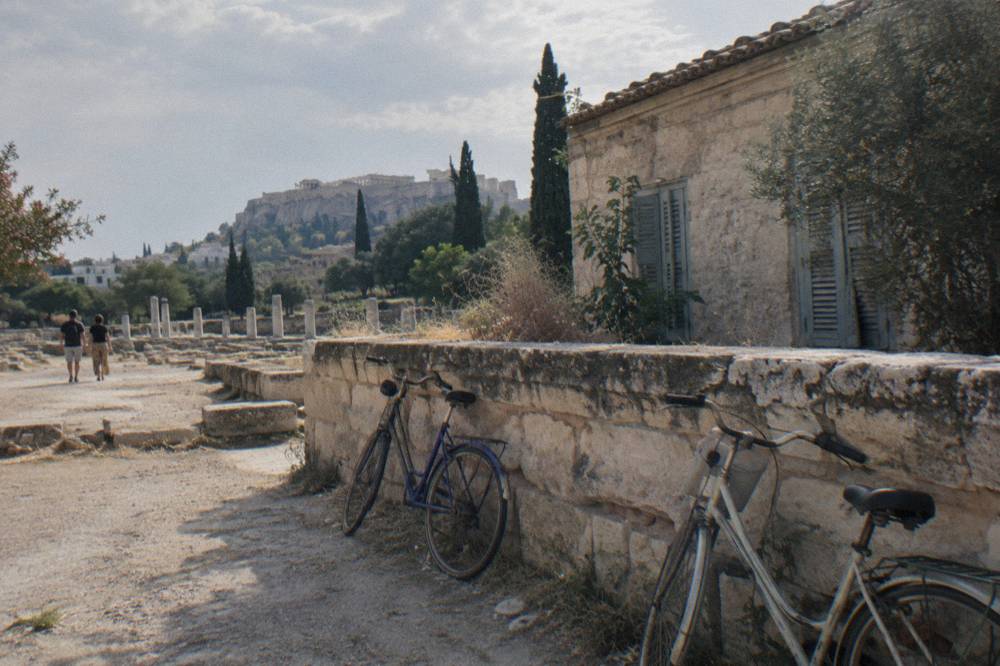
The practical translation is simple. A rider cannot navigate, photograph and pedal at the same time, and the guide handles the first of those anyway. Photography happens at stops, dismounted, which is also the comfortable way to shoot the Acropolis vistas. The cycling rules in Greece guide covers the full rule set for riders who want the whole picture, and families have a dedicated page in the Athens bike tour with kids guide.
The alcohol rule is worth naming too, because Athens evenings can drift toward ouzo. The road code sets its impairment threshold for every road vehicle, with the limit applying from 0.50 g/l blood, and it applies to cyclists the same as to drivers. A rider planning a wine stop mid-tour should let the guide set the pace, or better, pick a format where the drink comes at the end.
What Should You Leave At The Hotel?
Leave the big camera rig, the laptop, the passport photocopies you do not need, bulky towels and anything that cannot survive a bump: the tours move through busy streets, park the bikes at public stops, and give riders no secure storage beyond the bike itself. A day bag on a bike tour should be small enough to forget it is there.
The commonest mistake is the camera bag. Athens rewards photography more than almost any European city, and the instinct to bring the full kit is understandable, but the riding happens between the shots. A phone handles the stops, and a small camera in a closed pocket handles everything else. Anything that needs two hands to operate contradicts both the road code and the basic physics of riding in traffic.
Jewellery and watches come into the same category for a different reason: sweat and sun cream. A metal band on a hot handlebar-adjacent wrist is a minor irritation all ride long, and a smartwatch strapped to the handlebar for navigation turns a useful device into a hand-held violation if the rider touches it, which is why the phone mount stays home too. The Athens bike rental guide covers what an independent rider needs beyond this list.
One timing note for riders packing this month: the 43rd Athens Authentic Marathon runs on 7 and 8 November 2026, with traffic closures for all vehicles including bicycles on named central streets from 5 to 9 November, so a ride booked for that weekend may face rerouting, and packing an extra layer for the waiting is sensible. The event site has the full closure detail at the official marathon page.
Finally, the item that needs no packing at all: a little patience for the hills. Athens looks flat from below and is not. Riders who would rather not earn the views by pedal stroke can pick an e-bike format on nearly every route in the city, and the choice can be made at booking on the tours that list both options.
Common Questions About What To Bring On An Athens Bike Tour
Do I Need To Bring My Own Helmet?
No. Nearly every Athens tour on this site lists a helmet as included with the booking, including the Regular or E-Bike, Optional Acropolis tour and the Highlights Of Athens Biketour. Riders with their own helmet can bring it, but the supplied ones are part of the package.
Can I Bring A Backpack On The Tour?
Yes, a small one. Riders carry light bags on their backs or in baskets, and most routes make no provision for large luggage. Keep the bag small enough to ride with, and leave laptops and bulky items at the hotel.
Should I Bring Water Or Is It Provided?
Bring your own bottle regardless. Some tours list bottled water as included, such as the Historic E-Bike, 1.5 to 2.5 Hours ride, but summer rides in Athens heat call for more than a single included bottle provides. A refillable half-litre bottle covers a two-to-three-hour ride.
Can I Listen To Music Or Use My Phone While Riding?
No. Greek road rules ban headphones connected to audio devices and any hand-held phone or smartwatch use while riding, with fines of 350 EUR for both. Keep the phone in a closed pocket, save the music for the stops, and let the guide handle the navigation.
Do I Need My Passport For A Bike Tour?
Bring a passport or ID card. Guides check names against bookings, and riders are expected to identify themselves on Greek roads. A photocopy is a poor substitute, keep the document itself in a secure zippered pocket.
What Shoes Are Best For An Athens Bike Tour?
Closed, flat shoes with grip. The city's marble pavements turn slippery when dusty or wet, and the rides dismount at photo stops throughout. Trainers are the standard choice, flip-flops are the one thing to leave behind.